Table of Contents
The Complete Guide to Choosing the Best Home EV Charger
Electric vehicle adoption has reached a tipping point, and your home charging infrastructure matters more than ever. With federal tax credits expiring soon, new connector standards emerging, and innovative energy management features transforming how we power our vehicles, choosing the right home EV charger requires understanding a rapidly evolving landscape. This guide provides everything you need to make an informed decision—from product recommendations to installation costs, tax incentives to bidirectional charging capabilities.
The bottom line: Home charging remains the most convenient and cost-effective way to power your EV, with 90% of EV charging happening at home. Smart chargers can save you 60-80% on fuel costs compared to gasoline, while advanced systems with solar integration can slash your energy bills by $3,100-$3,400 annually. But timing matters—the federal 30% tax credit now expires June 30, 2026 (six years earlier than originally planned), making 2025 the critical year to act.
What’s new in 2025: The EV charging market has matured significantly with NACS (formerly Tesla’s connector) becoming the industry standard, load management systems that eliminate expensive electrical panel upgrades, and bidirectional charging transitioning from concept to reality. Major automakers including Tesla, GM, Ford, and BMW are standardizing V2H (vehicle-to-home) capabilities, effectively turning your EV into a massive backup battery. Meanwhile, prices for quality Level 2 chargers have become more competitive, ranging from $349-$750, with smart features now standard rather than premium additions.
Understanding charging levels and what you actually need
Before diving into specific products, you need to understand the fundamental difference between Level 1 and Level 2 charging—a choice that determines whether you wake up to a fully charged vehicle or one that’s barely gained any range overnight.
Level 1 charging uses your standard 120V household outlet, delivering a mere 3-5 miles of range per hour at 1.2-1.9 kW. For plug-in hybrid electric vehicles (PHEVs) with 20-40 mile electric ranges, this suffices for overnight charging. But for battery electric vehicles (BEVs) with 60-100 kWh batteries, Level 1 charging means 24-50+ hours for a full charge—impractical for daily use unless you drive less than 40 miles daily.
Level 2 charging operates at 240V (the same voltage as your electric dryer), delivering 12-60 miles of range per hour depending on amperage. This is the sweet spot for home charging. A typical 40-amp Level 2 charger provides 9.6 kW, fully charging most EVs in 4-8 hours overnight. Higher amperage options exist—32A (7.7 kW), 48A (11.5 kW), or even 50A (12 kW)—but your charging speed is ultimately limited by your vehicle’s onboard charger capacity, which typically ranges from 7.7-11.5 kW for most EVs.
The amperage decision matters for future-proofing. Installing a 60-amp circuit now (supporting 48 amps continuous) costs marginally more than a 40-amp circuit during initial installation but prepares you for faster-charging future vehicles. The National Electrical Code requires continuous loads to use only 80% of circuit capacity, so a 50-amp circuit provides 40 amps, a 60-amp circuit provides 48 amps, and so on.
Connector compatibility adds complexity in 2025. J1772 has been the North American standard since 2010, compatible with nearly all non-Tesla EVs. But NACS (SAE J3400)—Tesla’s connector standardized in 2024—is rapidly becoming the new default. Most 2025+ model year vehicles from Ford, GM, Rivian, Hyundai, Kia, Mercedes-Benz, Honda, and others will feature NACS ports. The good news: most charger manufacturers now offer both J1772 and NACS versions, and Tesla’s Universal Wall Connector accommodates both standards with a single unit.
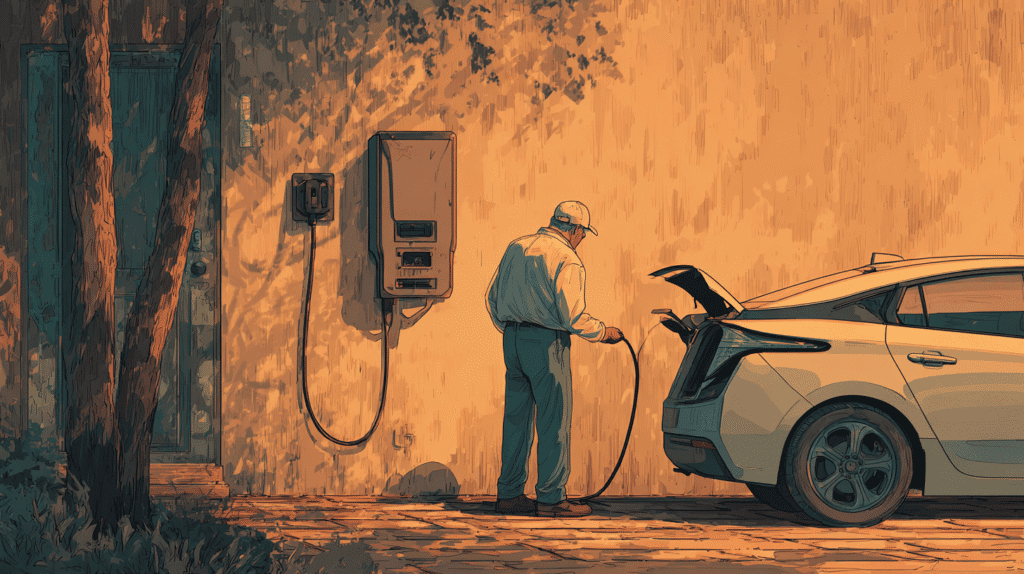
Top home EV chargers for 2025: models, pricing, and features
The home EV charger market in 2025 offers compelling options across every price point, with intense competition driving innovation while keeping prices reasonable. Here’s what’s available right now.
Budget tier champions: $349-$429
Emporia Classic ($399) stands out as the best value smart charger, earning “Best Overall Home EV Charger of 2024” from Good Housekeeping and “Best Smart EV Home Charger” from MotorTrend. At 48 amps hardwired or 40 amps plug-in (11.5 kW or 9.6 kW), it delivers maximum charging speed with WiFi connectivity, smart scheduling, energy monitoring, and time-of-use optimization. The 25-foot cable, NEMA 4 weatherproofing, and availability in both J1772 and NACS versions make it remarkably versatile. Many utilities offer rebates specifically for this model, potentially bringing your net cost below $200.
Grizzl-E Classic ($379.99) takes the crown for durability. This Canadian-engineered charger features a heavy-duty aluminum enclosure with NEMA 4 rating built to survive extreme weather—tested from scorching desert heat to Arctic cold. It’s a “dumb” charger without WiFi or app control, but that simplicity is its strength: no manufacturer servers to shut down, no subscription fees, just reliable 40-amp charging. The JuiceBox saga (manufacturer shut down operations in October 2024, discontinuing their app in July 2025) serves as a cautionary tale about smart charger dependence. For those prioritizing longevity and simplicity over connected features, Grizzl-E is unmatched.
Autel MaxiCharger AC Lite 40A ($399, frequently $379) won the 2025 MotorTrend Best Tech Award for its exceptional app experience. The ultra-thin flexible cable (0.7″ diameter), premium rubberized connector handle, and intuitive app interface make daily use delightful. WiFi, Bluetooth, and Ethernet connectivity provide flexibility, while the 3-year warranty and 9.6 kW output meet mainstream charging needs. If you value user experience and modern design, Autel delivers.
Lectron V-Box 48 ($359-$469) offers maximum power in the budget tier at 48 amps (11.5 kW) with a unique 2.75″ display screen showing real-time power draw, voltage, kWh consumed, and charging time—all without WiFi dependency. The IP55/NEMA 4 weatherproofing, 20-foot cable, and availability in both J1772 and NACS make it practical. For those who want local display feedback without cloud connectivity, this delivers.
Mid-range leaders: $429-$599
ChargePoint Home Flex ($549 hardwired, $599 plug-in) is Amazon’s #1 bestseller and earned its position through comprehensive smart features. The adjustable amperage (16-50A, providing 3.8-12 kW) lets you dial in exactly what your vehicle and electrical system support. But the real value lies in ChargePoint’s ecosystem: their app seamlessly integrates home and public charging, tracks costs down to the cent using your utility rates, schedules charging for off-peak hours, and provides detailed energy analytics. The 3-year warranty, ENERGY STAR certification, and 23-foot cable seal the package. For smart home enthusiasts wanting the most polished experience, ChargePoint justifies its premium.
Emporia Pro ($599, includes Vue 3 Home Energy Monitor) represents the biggest innovation of 2025. Its PowerSmart Load Management technology solves a critical problem: expensive electrical panel upgrades. Traditional wisdom says if your home has a 100-amp or 150-amp panel without spare capacity, you need a $1,500-$3,000 panel upgrade before adding EV charging. Emporia Pro eliminates this through dynamic load management, automatically adjusting charging power based on whole-home energy usage. The included energy monitor tracks 28 individual circuits, provides real-time data, and enables solar integration. For older homes with limited electrical capacity or multi-EV households, this is transformative.
Autel MaxiCharger AC Lite 50A ($569, often discounted to $455) delivers the fastest charging speed in this tier at 50 amps (12 kW) when hardwired. The cold-weather resistant cable rated to -40°C, advanced app with Apple-like design aesthetics, and 25-foot cable make it suitable for harsh climates and demanding users. The 3-year warranty and NEMA Type 4 rating provide confidence. If maximum charging speed matters and you’re willing to hardwire, this is the most affordable 50-amp option.
Premium and specialty options: $420-$750
Tesla Wall Connector (NACS-only: $420, Universal: $550) offers unbeatable value for Tesla owners or those future-proofing for the NACS transition. The NACS-only version charges Tesla vehicles at 48 amps (11.5 kW) with seamless app integration, power sharing between multiple units, and an ultra-slim cable. The industry-leading 4-year warranty demonstrates Tesla’s confidence. The Universal Wall Connector adds a J1772 adapter in an electronically locked housing, accommodating any EV with either connector type. For multi-EV households with mixed connector types or those anticipating future vehicle changes, the Universal version eliminates compatibility concerns.
Wallbox Pulsar Plus ($749, frequently $500-$650 on sale) is the most compact home charger available at just 8″x8″, with a premium finish that looks at home on any garage wall. The 40-amp version (48A available) delivers 9.6-11.5 kW, while smart features include power sharing, Alexa/Google Home integration, solar charging modes, and the myWallbox app for comprehensive control. The NEMA Type 4 weatherproofing and 25-foot cable are standard. If aesthetics matter or space is tight, nothing matches Wallbox’s compact design.
Grizzl-E Duo ($500-$600) is the most cost-effective dual-vehicle solution, featuring two J1772 connectors sharing a 40-amp circuit. Power automatically splits between vehicles, eliminating the need for two separate circuits and chargers. For two-EV households, this saves $500-$1,500 compared to two separate installations while requiring just one 50-amp circuit.
The NACS transition strategy
If you’re buying in 2025, consider your vehicle’s connector type and upgrade timeline. Current non-Tesla EV owners can safely purchase J1772 chargers—they’ll serve you for years and adapters exist if you later buy a NACS vehicle. New vehicle buyers should verify which connector their EV features and choose accordingly. The safest future-proof option is Tesla’s Universal Wall Connector ($550) or waiting for other manufacturers’ dual-connector models. Most importantly, ensure your chosen charger offers your vehicle’s connector type before purchasing.
Federal and state incentives: act before the June 2026 deadline
The economics of home EV charging improved dramatically with the Inflation Reduction Act, but recent legislative changes have created urgent timing pressure. Here’s what you need to know about available incentives and why acting in 2025 matters.
Federal 30C tax credit: now expiring June 30, 2026
The Alternative Fuel Vehicle Refueling Property Credit (IRS Form 8911, Section 30C) provides 30% of total installed cost up to $1,000 for residential EV charger installations. This covers the charger unit, installation labor, new electrical panel upgrades if needed, wiring, conduit, mounting hardware, and even bidirectional charging equipment.
Critical update: Originally scheduled to expire December 31, 2032, the “One Big Beautiful Bill” enacted July 4, 2025 accelerated the deadline to June 30, 2026—cutting the program by over six years. Your property must be fully operational (charger installed, inspected, and functional) by June 30, 2026 to qualify. This makes 2025 the crucial year for installation, allowing time for permitting, electrical work, and potential delays.
Geographic restriction: The credit applies only to installations in eligible census tracts—either low-income communities (poverty rate ≥20% or median family income ≤80% of statewide median) or non-urban areas. Approximately two-thirds of Americans live in qualifying locations. Verify eligibility using Argonne National Laboratory’s 30C Tax Credit Eligibility Locator tool before purchasing equipment. Enter your 11-digit census tract GEOID to confirm eligibility.
No income limits: Unlike EV vehicle purchase credits, the 30C charger credit has no income restrictions. Any taxpayer can claim it regardless of income level, provided they meet the geographic requirement.
Important considerations: The credit is non-refundable, meaning it can only reduce taxes owed, not create a refund. It applies to your principal residence only. Keep detailed documentation including itemized invoices separating equipment and labor costs, permits, inspection reports, installation photos, and equipment serial numbers.
Example calculation: Total installed cost of $3,500 (charger $500 + installation $2,000 + panel upgrade $1,000) yields $1,000 credit (30% would be $1,050, but capped at $1,000). Your net cost: $2,500.
State and utility incentives: stacking for maximum savings
State and local programs vary dramatically by location but can significantly increase total savings when combined with the federal credit. Major examples include:
California leads in incentives: Southern California Edison’s Charge Ready Home Rebate covers up to $4,200 for Level 2 installation. Los Angeles DWP offers up to $1,000 for the charger plus $250 for a dedicated meter, with an additional $500 for income-qualified customers (total up to $1,750). PG&E’s Residential Charging Solutions Rebate covers up to 100% of equipment costs for income-qualified customers. San Diego Gas & Electric, Sacramento Municipal Utility District ($750 Charge@Home program), and other California utilities offer substantial rebates. Combined with the $1,000 federal credit, California residents can achieve total incentives of $2,000-$5,200.
Colorado combines state and utility programs: Xcel Energy provides up to $500 for Level 2 chargers, increasing to $2,300 for income-qualified residents, plus up to $1,300 for wiring and panel upgrades. Black Hills Energy offers 50% up to $500 standard or 100% up to $1,300 for low-income residents. Multiple electric cooperatives offer $250-$1,250 rebates. The state’s Charge Ahead Colorado program provides grants covering 80-90% of Level 2 charger costs (up to $4,500 per port). Combined potential: $1,000 federal + $2,300-$4,500 state/utility = $3,300-$5,500 total.
New York offers business incentives: The Alternative Fuel Vehicle Refueling Property Credit provides 50% of cost up to $5,000 for businesses and commercial installations (available through end of 2025). Multiple utilities including Con Edison, National Grid, Central Hudson, and Orange & Rockland offer PowerReady programs covering up to 100% of make-ready infrastructure costs for Level 2 and DC fast charging.
Massachusetts targets multi-unit dwellings: National Grid’s program provides up to $3,900 per Level 2 port for individual installations and up to 100% of infrastructure costs for properties with 5+ units. The MassEVIP MUD Program covers up to 60% of hardware and installation costs, maximum $50,000 per address for multi-family properties.
Income-qualified programs: Many utilities offer enhanced rebates for low-income residents, typically verified through prior year tax returns showing adjusted gross income below thresholds or enrollment in public assistance programs (SNAP, TANF, Medicaid, LIHEAP, etc.). Enhanced rebates often provide 2-3x the standard amount or cover 100% of costs up to specified limits.
Stacking example (Colorado income-qualified resident):
- Federal 30C credit: $1,000
- Xcel Energy charger rebate: $2,300
- Xcel Energy wiring/panel rebate: $1,300
- Total incentives: $4,600
- Installed cost: $3,500
- Net cost after incentives: $0 (fully covered with $1,100 credit remaining)
How to claim incentives
Federal: Claim on your tax return for the year the equipment is placed in service using IRS Form 8911. File with Schedule 3 (Form 1040). Keep all documentation for at least 7 years. The credit carries forward if it exceeds your tax liability in the installation year.
State and utility: Most programs require pre-approval or applications submitted within specific timeframes. Many operate on a first-come, first-served basis until funds are depleted. Apply early in your state’s fiscal year (often July 1) for best availability. Some utilities require purchasing from approved vendor lists or certified installers. Check program-specific requirements before purchasing equipment.
Critical timing: With the June 30, 2026 federal deadline, plan installations for early-to-mid 2025 to accommodate permitting delays, electrician scheduling, potential supply chain issues, and inspection processes. Most jurisdictions require 2-4 weeks for permitting, and licensed electricians may have 3-8 week backlogs during busy seasons.
Technical standards and certifications you need to know
Understanding key technical standards helps you select safe, reliable equipment and ensures your installation meets electrical codes. Here’s what matters in 2025.
Safety certifications: the non-negotiables
UL 2594 is the primary standard for AC EV charging equipment (Level 1 and Level 2). This Underwriters Laboratories certification verifies the charger meets construction, enclosure, electrical safety, fire protection, and personnel safety requirements. Every charger must include a CCID (Charge Circuit Interrupt Device)—essentially a specialized GFCI for EV charging that protects against ground faults. Never purchase a charger without UL 2594 certification; non-certified equipment poses fire and electrocution risks and may void your homeowner’s insurance.
ENERGY STAR certification indicates the charger meets EPA efficiency standards, using 40% less energy in standby mode compared to non-certified models. For AC chargers, this represents minimum thresholds for standby power consumption. Beyond efficiency, ENERGY STAR certification is required for many federal, state, and utility rebate programs. The NEVI Formula Program mandates ENERGY STAR for all AC Level 2 chargers receiving federal funding. Verify certification before purchasing if you plan to claim incentives.
UL 2252 is a new 2025 standard for EV charging adapters, addressing safety concerns following catastrophic failures with non-certified NACS-to-CCS adapters. CharIN (Charging Interface Initiative) issued warnings in April 2025 about adapter failures. Only use OEM-provided adapters or those with UL 2252 certification from approved manufacturers like A2Z EV, Amphenol, and Lectron.
Weatherproofing ratings matter for outdoor installations. NEMA (National Electrical Manufacturers Association) Type 3R provides basic protection against rain, sleet, and snow—the minimum for outdoor use. NEMA Type 4 adds protection against windblown dust, splashing water, and hose-directed water—the standard recommendation for outdoor EV chargers. NEMA Type 4X adds corrosion resistance, crucial for coastal installations with salt air exposure. Equivalent IP (Ingress Protection) ratings are IP65 (similar to NEMA 4) and IP67 (submersion protection for flood-prone areas).
OCPP compliance enables charger interoperability with management systems. OCPP 2.0.1 (accepted as IEC 63584 international standard in 2024) and the newly released OCPP 2.1 (January 2025) provide enhanced security, Plug & Charge capabilities, and V2G support. While primarily important for commercial installations, OCPP compliance offers flexibility for home users wanting advanced energy management or participating in utility programs. The NEVI Formula Program mandates OCPP 2.0.1 or equivalent for federally funded chargers.
Hardwired vs. plug-in installation: the great debate
This decision fundamentally impacts your installation cost, flexibility, and charging speed. The National Electrical Code’s 2023 updates shifted recommendations, and understanding why helps you choose correctly.
Hardwired installation connects the charger directly to your electrical panel via a dedicated circuit without an outlet. This approach is strongly recommended for continuous loads over 40 amps per NEC 2023, and many jurisdictions now mandate it for high-power installations. Advantages include maximum power delivery (up to 48 amps continuous on a 60-amp circuit), more stable connections without plug/outlet wear, no GFCI outlet requirement (the charger has internal protection), cleaner appearance, and lower long-term failure risk. Disadvantages: you can’t take the charger if you move, higher installation labor cost initially, and changing chargers requires an electrician.
Plug-in installation uses a heavy-duty outlet (typically NEMA 14-50 or 6-50 for 50-amp circuits, or NEMA 14-30 for 30-amp circuits) with the charger plugging in. Maximum continuous output is 40 amps on a 50-amp circuit due to the 80% rule. Advantages include portability when moving, easy charger upgrades, and the outlet can serve other purposes (RV charging, welders, etc.). Disadvantages are more significant: the 2020 NEC requires GFCI protection for garage and outdoor outlets, which frequently causes nuisance tripping when combined with the charger’s internal protection systems. Cheap household-grade outlets (costing $10-$20) aren’t rated for continuous EV loads and can overheat, melt, or cause fires—you must use industrial/commercial-grade EV-rated outlets, which are surprisingly expensive.
Critical safety note for plug-in: Many house fires have resulted from cheap NEMA 14-50 outlets overheating during EV charging. The outlet must be commercial-grade, designed for continuous duty, properly torqued during installation, and paired with a GFCI breaker. The GFCI requirement creates reliability problems because GFCI breakers plus the charger’s internal CCID protection often conflict, causing charging interruptions. This combination frustrates many EV owners and leads electricians to recommend hardwired installations.
Recommendation: Hardwire if you’re planning to stay in your home 5+ years, want maximum reliability and charging speed, or need over 40 amps. Use plug-in only if you’re renting, plan to move within 5 years, want ultimate flexibility, or your vehicle’s onboard charger is limited to 32 amps or less anyway.
The NACS standardization march
SAE International established J3400 (NACS) as a Recommended Practice in August 2024, cementing Tesla’s connector as the new North American standard. Major automakers announced adoption for 2025-2026 model years: Ford and Rivian began in 2024, GM’s entire 2026 model year lineup features NACS, and Hyundai, Kia, Genesis, Honda, Nissan, Toyota, Mercedes-Benz, BMW, Volvo, and Polestar follow by 2026-2027.
The transition creates temporary complexity but long-term simplification. NACS offers significant advantages: a single compact connector handles both AC and DC charging (unlike CCS which requires separate pins), it’s smaller and more ergonomic than CCS1, and it supports up to 1 MW theoretical power for future ultra-fast charging. The federal government endorsed NACS in December 2023, with FHWA allowing J3400/NACS on federally funded chargers provided CCS1 is also supported (via adapter or dual connector).
For home charging, J1772 remains dominant in 2025 simply due to installed base—most existing chargers use J1772. But charger manufacturers rapidly added NACS versions of popular models (Grizzl-E, Emporia, Lectron, Autel all offer NACS options). Tesla’s Universal Wall Connector ($550) provides both standards in one unit with an electronically locked adapter, eliminating future concerns.
Your strategy: Purchase the connector type matching your current vehicle. If you’re buying a 2025+ model year EV, verify which connector it has—many models still ship with J1772 in 2025 with NACS arriving in 2026. Adapters provide compatibility (all NACS vehicles receive J1772 adapters from manufacturers), but native connections are always preferable for reliability and simplicity.
Smart features and energy management: the hidden value
The gap between basic and smart chargers has narrowed dramatically in 2025, with WiFi connectivity, mobile apps, and scheduling now standard features rather than premium additions. But advanced energy management capabilities separate good chargers from transformative ones, potentially saving thousands annually.
Scheduling and time-of-use optimization
Every smart charger in 2025 offers scheduled charging—set times when charging starts and stops. This basic feature matters enormously because most utilities offer time-of-use (TOU) rate plans with dramatic price differences between peak and off-peak periods.
Consider real-world examples: PG&E’s cheapest rates run midnight to 3pm, while peak rates (4-9pm) cost 3-4x more. Southern California Edison’s TOU-D-PRIME plan makes 8am-4pm charging equivalent to less than $2 per gallon of gasoline. PECO in Pennsylvania charges $0.04/kWh during super off-peak (midnight-6am) versus $0.20/kWh during peak—an 80% discount. Oakland residents using TOU plans pay the equivalent of $1.03 per gallon for EV “fuel” versus $3.34 per gallon on standard rates—a 69% savings just from timing.
The annual impact: Average EV drivers spend $672/year on home charging at typical $0.16/kWh rates, compared to $1,744/year for gasoline vehicles—an $800+ annual savings. Optimizing with TOU scheduling increases this to $1,000+ savings. Over a vehicle’s lifetime, this compounds to $6,000-$10,000 saved versus gasoline, with TOU optimization adding another $2,000-$3,000.
Smart chargers handle this automatically. Set your desired departure time, the charger determines how much energy is needed, and it draws power exclusively during the cheapest periods. Sophisticated systems like ChargePoint Home Flex and Ohme Home Pro integrate your utility’s specific rate schedule, automatically updating when rates change seasonally.
Load management for panel upgrade avoidance
Emporia’s PowerSmart technology and similar systems from Wallbox and others solve one of home EV charging’s biggest obstacles: insufficient electrical panel capacity. Many homes have 100-amp or 150-amp service panels, and adding a 50-amp circuit for EV charging when you’re already using 90+ amps for HVAC, water heater, and appliances mathematically exceeds safe capacity. Traditional solution: upgrade to a 200-amp panel for $1,500-$3,500.
Dynamic load management eliminates this expense. CT (current transformer) clamps monitor your home’s total real-time electrical draw. The charger continuously adjusts its power consumption to ensure the total never exceeds your panel’s capacity. When your air conditioning cycles on (20 amps), the charger automatically reduces from 48 amps to 28 amps. When the AC shuts off, the charger ramps back up. This happens seamlessly in the background.
The Emporia Pro ($599) includes monitoring for 28 individual circuits, providing unprecedented visibility into energy usage throughout your home. Beyond preventing panel upgrades, this identifies energy-wasting appliances and optimizes overall consumption. For multi-EV households, load management becomes essential—it’s the difference between needing two separate 60-amp circuits ($2,000-$4,000 for second circuit installation) versus sharing a single circuit intelligently.
Performance metrics from deployed systems show 25.3% peak load reduction, 87.4% resource utilization efficiency, and 3.5-minute average wait times when multiple vehicles charge simultaneously. The savings from avoided panel upgrades alone justify the smart charger premium—a $599 charger with load management versus a $400 basic charger plus $2,500 panel upgrade makes the smart charger $2,300 less expensive overall.
Solar integration and battery systems
EVs and solar panels form a natural partnership—your rooftop generates clean, cheap electricity that powers your transportation. But timing matters. Solar produces peak power midday (10am-3pm) when many EVs sit empty at workplaces, while vehicles typically charge overnight when solar produces nothing. Home battery systems bridge this gap, but smart chargers increasingly enable direct solar charging.
Three solar charging modes exist in 2025:
Solar-assisted mode (Eco mode) prioritizes solar power but supplements with grid electricity to maintain consistent charging. Your vehicle charges at full speed, drawing first from solar production, then adding grid power as needed. This maximizes solar self-consumption while ensuring adequate charging speed. Available on Zappi V2, Smappee EV Wall, Wallbox Pulsar Plus with EMS, and Ohme Home Pro.
Solar-only mode (Eco+ mode) uses exclusively excess solar generation, pausing charging when solar production is insufficient. This maximizes environmental benefits and self-consumption but requires surplus solar capacity and flexible charging needs. If clouds roll in, charging pauses until sun returns. Ideal for those with large solar arrays (8+ kW), home battery systems, and predictable schedules allowing daytime charging. Available on Zappi V2, Anderson A2, EO Mini Pro 3, and Ocular IQ Solar.
Smart solar-grid blending uses AI and prediction algorithms to optimize between solar and grid charging. The system learns your solar production patterns, vehicle usage, and electricity rates, automatically scheduling to maximize solar use while ensuring the vehicle is ready when needed. This provides the best balance of solar utilization and convenience. Systems like Smappee’s AI-optimized solar charging and go-e Charger’s 15-minute PV-load prediction deliver this sophistication.
Requirements: Solar integration requires CT meters to measure both solar generation and home consumption, allowing the charger to determine excess production available for the EV. Some systems include CT meters (Smappee, Ohme), while others require separate purchase and installation ($200-$400). The charger must support communication protocols like OCPP, MQTT, or HTTP to receive solar production data.
Economics: Home solar typically saves $700-$800 annually versus grid electricity, with additional savings of $125/year when factoring in system costs. Combining solar with EV charging optimizes ROI on both investments—your $15,000-$25,000 solar installation now powers both your home and transportation. Combined annual savings reach $3,100-$3,400 with typical payback periods of 5-8 years, followed by 15-20 years of profit.
Tesla Powerwall 3 integration represents the state-of-the-art for 2025. The latest Powerwall (11.5 kW continuous, 13.5 kWh storage) includes integrated solar inverter, whole-home backup capability, and “Charge on Solar” features. Set to Self-Powered mode, the system automatically adjusts vehicle charging power every 10 seconds to match excess solar production, storing any surplus in the Powerwall for later use, and drawing from the battery during nighttime vehicle charging. This creates a fully integrated solar-battery-EV ecosystem. While full features require Tesla vehicles, the architecture works with third-party chargers and EVs at varying capability levels.
Alternative battery systems from Enphase (IQ series), Franklin WH (aPower 2 with 15 kWh usable), and Sigenergy (universal bidirectional DC charger enabling V2X for non-Tesla vehicles) offer similar integration. The Sigenergy system is particularly notable as it enables any CCS-equipped EV to function as backup power through bidirectional charging—effectively turning your EV into an additional home battery.
AI and machine learning optimization
Cutting-edge systems deployed in 2025 use artificial intelligence for predictive optimization, learning patterns from your behavior and adapting in real-time to maximize savings and convenience.
Smart scheduling algorithms analyze your historical driving patterns, arrival/departure times, electricity rates, solar production patterns, and weather forecasts. The AI calculates optimal charging strategies that minimize costs while ensuring adequate range when you need it. Some systems achieve 95.2% prediction accuracy, translating to near-optimal energy cost reduction without user intervention.
Real-world results from commercial deployments show ToU optimization reducing costs by 14.27-19.28% compared to immediate charging. For residential users, this translates to $100-$300 additional annual savings beyond basic TOU scheduling. The system continuously learns and improves—if you unexpectedly leave early on Thursdays, the AI adapts charging schedules to ensure readiness.
Grid integration AI coordinates with utility signals for demand response events. When grid stress occurs (heat waves causing air conditioning spikes), utilities can request temporary charging pauses or reductions, compensating participants through programs paying $2/kWh for dispatched energy or $30-40 per kW per month for frequency regulation services. Algorithmic coordination handles the complexity automatically, maximizing your compensation while minimally impacting your convenience.
Installation requirements and real-world costs
Understanding installation complexity and costs prevents surprises and helps you budget accurately. Prices vary dramatically based on circumstances, but here’s what to expect in 2025.
Electrical panel assessment
Your panel capacity determines installation complexity. Most homes have 100-amp, 150-amp, or 200-amp electrical service. A Level 2 EV charger typically requires a 50-60 amp dedicated circuit. Calculate your available capacity by totaling existing circuit breakers—if you’re already at 80-90% of panel capacity, adding EV charging may require an upgrade.
Panel upgrade costs range $1,500-$3,500 depending on complexity, location, and whether the utility service entrance also requires upgrading. Many utilities provide free or discounted service entrance upgrades to support EV adoption—check with your utility before assuming you’ll pay full price. Some utilities even offer rebates specifically for panel upgrades needed for EV charger installation.
Load management avoids upgrades. As discussed earlier, systems like Emporia Pro, Wallbox EMS, and Tesla Power Sharing dynamically balance loads to stay within your existing panel capacity. This transforms a $3,000 panel upgrade requirement into a $200 premium for a smart charger—a $2,800 savings.
Installation cost ranges
Simple installation ($500-$1,200): Electrical panel is in the garage or adjacent to the charging location, less than 25 feet of wire run required, no obstacles, standard residential wiring, no trenching needed, one-day installation. This represents about 60% of residential installations.
Moderate installation ($1,200-$2,500): Panel is 25-50 feet from charging location, requires running conduit along exterior walls or through basement/crawlspace, may need small amount of concrete patching for conduit mounting, permits required (typically $100-$300 depending on jurisdiction), 1-2 day installation.
Complex installation ($2,500-$5,000+): Panel is 50+ feet from charging location, requires trenching for underground conduit runs, charging location is in detached garage requiring separate subpanel installation, extensive concrete work needed, significant obstacles (finished walls requiring drywall repair, landscaping restoration), or panel capacity insufficient requiring upgrades. These represent about 15% of installations but account for a disproportionate share of horror stories.
Wire distance matters enormously. Copper wire is expensive (6 AWG copper costs $3-$5 per foot), and long runs may require larger gauge wire to minimize voltage drop. A 100-foot run to a detached garage might need 4 AWG or even 3 AWG wire ($6-$9 per foot), plus trenching costs of $5-$10 per linear foot, plus conduit at $2-$3 per foot. This scenario can easily hit $2,000-$3,000 for materials alone before labor.
Labor costs for licensed electricians range $75-$150 per hour depending on location and demand. Urban areas (New York, San Francisco, Los Angeles) skew high-end ($125-$150), while rural and suburban areas average $75-$100. Expect 4-8 hours of labor for simple installations, 8-16 hours for moderate complexity, and 16-24+ hours for complex projects.
Permit and inspection requirements
Most jurisdictions require electrical permits for 240V/50+ amp circuits. Permit costs typically range $100-$300, and inspections are mandatory before energizing the circuit. Timeline varies—some jurisdictions issue permits within days, others require 2-4 weeks. Factor this into your planning, especially with the June 2026 federal tax credit deadline.
Inspection failures usually result from improper wire gauge selection, incorrect GFCI installation, improper grounding, or missing disconnect switches. Using a licensed, experienced electrician minimizes this risk. Many electricians offer fixed-price quotes including permit fees and inspection corrections.
DIY vs. professional installation
While technically-inclined homeowners can install plug-in chargers themselves (running the circuit, installing the outlet, mounting the charger), electrical work requires permits and inspections in most jurisdictions. More importantly, improper installation creates fire and electrocution hazards. Unless you’re a licensed electrician or have extensive electrical experience, professional installation is strongly recommended and often required by charger warranties, homeowner’s insurance policies, and local codes.
EVITP certification (Electric Vehicle Infrastructure Training Program) identifies electricians with specialized EV charging training. While not always required, EVITP-certified electricians understand EV-specific requirements, can optimize installations, and often work faster due to experience. Many utilities maintain lists of EVITP-certified installers and some offer enhanced rebates when using certified professionals.
Total project cost examples
Scenario 1 – Simple installation, budget charger:
- Grizzl-E Classic charger: $380
- Simple hardwired installation: $600
- Permit and inspection: $150
- Total: $1,130
- Federal credit (30%): -$339
- Net cost: $791
Scenario 2 – Moderate installation, smart charger with utility rebate:
- ChargePoint Home Flex: $549
- Moderate installation (40-foot run): $1,800
- Permit: $200
- Total: $2,549
- Federal credit: -$765 (30% of $2,549)
- Utility rebate (CA SCE example): -$500
- Net cost: $1,284
Scenario 3 – Complex with panel upgrade, premium smart charger:
- Tesla Universal Wall Connector: $550
- Panel upgrade (150A to 200A): $2,500
- Complex installation (detached garage): $3,000
- Permits and inspection: $300
- Total: $6,350
- Federal credit: -$1,000 (30% would be $1,905, but capped at $1,000)
- State/utility rebates: -$750
- Net cost: $4,600
Scenario 4 – Load management avoiding panel upgrade:
- Emporia Pro with load management: $599
- Moderate installation: $1,500
- Permit: $150
- Total: $2,249
- Federal credit: -$675
- Utility rebate: -$500
- Net cost: $1,074
- Avoided panel upgrade savings: $2,500
- Effective cost after avoided upgrade: -$1,426 (you saved money overall vs. basic charger with panel upgrade)
These examples illustrate why planning matters—spending more initially on smart chargers with load management often costs less overall when avoiding panel upgrades.
Bidirectional charging: your EV as a home battery
The most transformative development in 2025 EV charging is the mainstreaming of bidirectional power flow, turning your electric vehicle into a massive mobile battery that can power your home during outages, reduce electricity bills through peak shaving, and even earn revenue providing grid services.
Understanding V2H, V2G, and V2L
Vehicle-to-Home (V2H) allows your EV to power your house using its battery. A typical EV with a 60-80 kWh battery provides 2-3 days of backup power for an average home, with larger batteries like the Ford F-150 Lightning’s 131 kWh extended range offering up to 10 days. Unlike stationary home batteries (Tesla Powerwall provides 13.5 kWh), your EV battery is 4-10 times larger. Systems automatically detect grid outages and seamlessly switch to battery power, running critical loads or your entire home depending on configuration.
Vehicle-to-Grid (V2G) extends V2H by allowing power export back to the utility grid during peak demand. Your EV becomes a distributed energy resource participating in grid stabilization, frequency regulation, and demand response programs. Utilities compensate you for this service—rates of $30-40 per kW per month for frequency regulation, $2/kWh for dispatched energy during peak events, and various demand response payments. The technology responds incredibly fast (800-1000 milliseconds) to grid signals, making EVs ideal for frequency regulation.
Vehicle-to-Load (V2L) is the simplest form, powering devices and appliances directly from the EV without home integration. Most Hyundai, Kia, Genesis, BYD, and MG vehicles include V2L with 1.5-3.6 kW capacity. This powers camping equipment, job site tools, or emergency medical devices without special infrastructure—just an adapter connecting to the vehicle’s charge port. V2V (vehicle-to-vehicle) charging lets one EV charge another, useful in emergency situations.
Available vehicles and equipment
Vehicles with bidirectional capability have expanded dramatically in 2025:
Currently available: Ford F-150 Lightning (V2H, 9.6 kW), Nissan Leaf (V2H/V2G, 7 kW, CHAdeMO), Hyundai Ioniq 5 & 6 (V2L, 3.6 kW), Kia EV6 & EV9 (V2L/V2H), Genesis GV60/GV70/G80 (V2L), Mitsubishi Outlander PHEV (V2G/V2H/V2L), VW ID.3/ID.4 with 77 kWh battery (V2H), BYD Atto 3/Dolphin/Seal/Shark (V2L, 3.3 kW), MG4/ZS EV (V2L), Tesla Cybertruck (V2H/V2L, 11.5 kW with Powershare).
Coming 2025-2026: All Tesla models (bidirectional confirmed for 2025), all GM Ultium platform EVs for 2026 model year (Silverado EV, Blazer EV, Equinox EV, new Bolt EV, GMC Sierra EV, Hummer EV, Cadillac Lyriq/Escalade IQ/OPTIQ), BMW iX3 (Spring 2026 with BMW Wallbox Professional), Mercedes-Benz new generation EVs, Volvo EX90/EX30 (V2H standard), Polestar 3 & 4, Honda Acura RSX and all Honda global EV platform vehicles, Ram 1500 REV, Hyundai Ioniq 9.
Bidirectional chargers for home installation:
Wallbox Quasar 2 ($5,000-$7,500 estimated) provides 11.5 kW bidirectional charging for CCS-equipped vehicles (currently compatible with Kia EV9, more expected). Features V2G and V2H with automatic blackout backup, whole-home support up to 200A service, and solar charging modes. Available through California and Connecticut Bidirectional Energy programs with up to 75% subsidies, reducing net cost to $1,250-$1,875.
Ford Charge Station Pro + Home Integration System ($1,310 charger + $12,000-$15,000 complete system) delivers 19.2 kW charging and 9.6 kW discharge exclusively for Ford F-150 Lightning. The complete system includes a Delta 10kW bidirectional inverter, transfer switch, and installation through Sunrun partnership. Provides Intelligent Backup Power with automatic grid transfer and solar integration.
GM Energy PowerShift Charger + V2H Enablement Kit ($7,299 for V2H bundle including charger, inverter, Home Hub, and black start battery; $12,700 with 10.6 kWh home battery) works with all Ultium-based GM EVs starting with 2026 model year. Offers 19.2 kW charging and 9.6 kW discharge, 200A grid connection, islanding capability, and scalable battery storage. Leasing program launching 2026 reduces upfront costs.
Sigenergy SigenStor System (AU$6,000/US$4,000 for 12.5kW, AU$7,000/US$5,000 for 25kW) represents the most affordable bidirectional system per kW. This hybrid system integrates solar, battery, and EV charging with DC-coupled charging, off-grid UPS capability, and CCS connector compatibility. Currently supports V2H with V2G pending regulatory approval.
Enphase IQ Bidirectional EV Charger ($4,000-$5,000 estimated) is delayed to second half 2026 but promises universal compatibility through ISO 15118-20 and OCPP 2.1 standards. Features GaN-based microinverters, Black Start technology for grid-forming capability, AI-powered energy management, and integration with IQ Meter Collar for comprehensive V2H/V2G.
Benefits and economics
Cost savings from time-of-use arbitrage: Charge during off-peak hours (8-15 cents/kWh) and discharge during peak hours (30-50 cents/kWh). Example: Store 20 kWh overnight at $0.15/kWh ($3 cost), discharge 15 kWh during peak at $0.50/kWh ($7.50 value), net $4.50 daily profit = $1,640 annually. Conservative usage avoiding excessive cycling yields $120-$150 annual savings, while optimal usage reaches $2,500+ annually.
Grid services revenue: Frequency regulation payments of $30-40 per kW per month mean a 10 kW capable system generates $300-400 monthly = $3,600-$4,800 annually. Demand response programs like California’s ELRP pay $2/kWh for energy dispatched, and Maryland BGE programs compensate for peak period discharge. PG&E’s V2X pilot offers up to $5,175 in incentives just for participation. National Grid New England has 8,000 active V2G participants generating regular revenue.
Backup power value: Eliminate the need for a standby generator ($5,000-$15,000 for whole-home systems plus ongoing maintenance) or multiple home batteries (4-10 Tesla Powerwalls at $11,500 each would cost $46,000-$115,000 for equivalent capacity). Your EV already sitting in the garage provides this capability once bidirectional charging is enabled. During Hurricane Ian, Texas grid failures, and California wildfire-related power shutoffs, Ford F-150 Lightning owners successfully powered homes for 3-10 days.
Solar integration value: Bidirectional charging combined with solar enables storing midday solar production for evening use (when TOU rates peak), instead of exporting at low rates (3-5 cents/kWh) and buying back at high rates (30-50 cents/kWh). This increases solar ROI by 30-50% for typical installations.
Barriers and realities
Despite the promise, significant barriers remain. High upfront costs of $12,000-$15,000 for complete V2H systems deter adoption, though utility subsidies of 50-75% dramatically improve economics. Limited vehicle availability means most EVs on the road aren’t bidirectional-capable, requiring new vehicle purchases to access the technology. Regulatory fragmentation creates a patchwork of requirements—19 states have V2G programs, but interconnection standards, compensation structures, and utility approval processes vary widely.
Battery degradation concerns persist despite studies suggesting EV batteries outlast vehicles even with bidirectional use. Manufacturers slowly address this through warranties, but consumer perception remains a barrier. User reluctance stems from flexibility concerns—studies show only 42% likely to participate in V2G due to range anxiety and worry about vehicle availability when needed.
Vendor lock-in risks are real. Ford’s system works only with F-150 Lightning. GM’s system requires Ultium platform vehicles. This proprietary approach contrasts with universal standards like CCS and ISO 15118-20. As the market matures, standardization should reduce this concern, but early adopters face compatibility limitations.
Timeline and outlook
V2L is mainstream now—available on 20+ vehicle models requiring only adapters. V2H transitions from early adopter to mainstream adoption in 2025-2027 as Tesla, GM, and other major automakers deliver on commitments. V2G remains limited to specific utility programs but should achieve significant scale by 2028-2032 as regulatory frameworks solidify and compensation structures standardize.
Market projections show V2G growing from $14 million (2024) to $117 million (2032) to $4.5+ billion (2033), with bidirectional charging overall reaching $9.1 billion by 2034. By 2040, EVs could supply up to 20% of Europe’s peak electricity demand—a massive distributed energy resource.
For 2025 adoption decisions: Consider V2H if you experience frequent outages, have high electricity rates with significant TOU differentials, already have solar, or prioritize energy independence. The technology is proven and systems are available now, though expensive. Take advantage of utility incentives where available—75% subsidies transform economics dramatically. V2L offers immediate value for $100-$300 in adapters with no installation complexity.
Choosing the right charger for your situation
With products, incentives, technologies, and costs understood, here’s how to select the optimal solution for specific circumstances.
Homeowners planning to stay 5+ years
Recommendation: Invest in a quality hardwired smart charger matched to your vehicle’s onboard charger capacity or higher for future-proofing. The ChargePoint Home Flex ($549-$599) offers the most comprehensive ecosystem, app polish, and compatibility with utility programs. For those prioritizing maximum charging speed and extreme durability, the Autel MaxiCharger AC Lite 50A ($455-$569) delivers 12 kW with cold-weather capability. If budget is primary concern, the Emporia Classic ($399) provides exceptional smart features at an affordable price.
If your electrical panel is at capacity, the Emporia Pro ($599) with load management eliminates expensive panel upgrade requirements while providing whole-home energy monitoring—a $2,500-$3,000 net savings versus basic charger plus panel upgrade.
Multi-EV households should strongly consider either individual smart chargers with integrated load management (Wallbox EMS, Tesla Wall Connector with power sharing) or the Grizzl-E Duo ($500-$600) for cost-effective dual-vehicle charging on a single circuit.
Renters or homeowners planning to move within 5 years
Recommendation: Plug-in installation provides portability. The ChargePoint Home Flex plug-in version ($599) or Grizzl-E Smart ($440) with NEMA 14-50 plug allows taking the charger to your next home. Installation costs are typically lower since you’re adding an outlet rather than hardwiring, though the GFCI requirement may cause headaches.
Alternatively, consider whether Level 1 charging (standard 120V outlet) meets your needs if you drive under 40 miles daily. Many PHEVs and even some BEVs can manage on Level 1 for daily driving, reserving DC fast charging for road trips. This eliminates installation costs entirely, though convenience suffers.
Verify your lease or rental agreement allows EV charger installation and clarifies who owns the installed equipment. Some landlords agree to installation if they retain the charger when you leave, effectively installing EV infrastructure at tenant expense—negotiate carefully.
Multi-unit dwelling residents (apartments, condos)
Recommendation: This scenario has unique challenges but improving solutions. Many states now have “right to charge” laws requiring landlords and HOAs to allow EV charger installation, though cost responsibility varies. Approach your property management with information about utility programs for multi-unit dwellings—many offer enhanced incentives covering 75-100% of costs for properties with 5+ units.
National Grid (Massachusetts) provides up to 100% of make-ready infrastructure costs for MUD properties. California’s SVCE Multifamily program offers up to $100,000 per property with 75-100% cost coverage. These dramatically reduce landlord objections since their out-of-pocket expense approaches zero.
Networked smart chargers with RFID authentication or app-based access control enable shared installations with individual billing. ChargePoint, Wallbox, and others offer solutions designed for MUD scenarios where multiple residents share infrastructure.
If property management refuses, check your city/state laws—California Civil Code Section 4745, Oregon HB 2180, Colorado HB 1298, Florida SB 398, and similar laws in other states limit HOA authority to prohibit EV charging infrastructure.
Tesla owners
Recommendation: The Tesla Wall Connector ($420 for NACS-only, $550 for Universal) offers unbeatable value with seamless app integration, power sharing capability for multiple Tesla vehicles, and the industry-leading 4-year warranty. The Universal version adds J1772 compatibility with an electronically locked adapter, future-proofing for potential non-Tesla vehicles.
However, don’t overlook third-party options. The ChargePoint Home Flex offers superior app features and energy monitoring. The Emporia Pro provides load management that Tesla’s charger lacks (though Tesla chargers can share power with each other). Third-party chargers are often eligible for larger utility rebates than Tesla’s own equipment.
Owners of multiple EVs with different connectors
Recommendation: The Tesla Universal Wall Connector ($550) directly solves this with built-in J1772 and NACS support via integrated adapter. Alternatively, purchase separate chargers for each connector type, which offers flexibility for simultaneous charging if you have sufficient electrical capacity.
For J1772 chargers, high-quality NACS adapters (UL 2252 certified only) enable compatibility with NACS vehicles, though native connections are preferable. Budget for $100-$200 per quality certified adapter.
Dual charging setups benefit enormously from load management—Emporia Pro, Wallbox EMS, or Tesla’s power sharing prevent overloading your electrical panel when both vehicles charge simultaneously.
Homes with solar panels (with or without batteries)
Recommendation: Prioritize chargers with explicit solar integration: Zappi V2 (Eco and Eco+ modes with wireless CT sensors), Smappee EV Wall (AI-optimized solar with integrated 28-circuit monitoring), Wallbox Pulsar Plus with EMS add-on (Eco-mode), or Ohme Home Pro (dynamic tariff optimization including solar). These systems maximize solar self-consumption, often increasing solar ROI by 30-50% by shifting vehicle charging to high-solar production periods.
If you have or plan to add home battery storage, Tesla’s ecosystem (Powerwall 3 + Wall Connector + Tesla vehicle) offers the most seamless integration with the Charge on Solar feature adjusting power every 10 seconds. Alternative battery systems (Enphase IQ, Franklin WH, Sigenergy) work with OCPP-compliant chargers for similar functionality.
Calculate combined economics: a 7 kW solar system ($15,000-$18,000 after federal solar ITC) plus smart EV charger ($400-$600) plus home battery ($10,000-$15,000 for 13-15 kWh) creates an integrated energy ecosystem. Combined annual savings of $3,100-$3,400 yield 5-8 year payback, followed by 15-20 years of profit. Bundling installations saves 20-30% on labor versus separate projects.
Budget-conscious buyers
Recommendation: The Grizzl-E Classic ($380) provides exceptional value for those not needing smart features—maximum durability and reliability with no ongoing dependencies on manufacturer servers or apps. Installation costs matter more than charger price for budget builds, so simple installations (short wire runs, existing panel capacity) are key.
Alternatively, the Emporia Classic ($399) adds smart features for minimal premium—enough to qualify for utility rebates requiring WiFi connectivity, potentially making it cheaper net cost than the Grizzl-E despite higher sticker price.
Maximize incentives: ensure charger has ENERGY STAR certification (required for many rebates), verify your address qualifies for the federal 30C credit, apply for state/utility rebates before purchasing, and consider income-qualified programs if eligible (can cover 100% of costs in some cases).
Early adopters wanting bidirectional capability
Recommendation: Confirm your vehicle supports bidirectional charging or commit to purchasing one that does. Current options include Ford F-150 Lightning (with Ford Charge Station Pro system, $12-15K complete), Kia EV9 (with Wallbox Quasar 2, $5-7.5K, up to 75% off in some states), or wait for 2026 GM Ultium vehicles (with GM Energy PowerShift system, $7.3K bundle or leasing option).
Research utility programs actively—California’s PG&E V2X pilot, Maryland BGE V2G program, and various demand response programs can provide $2,000-$5,000+ in incentives plus ongoing revenue. Without utility program participation, V2H payback period extends to 8-15+ years; with programs, this shortens to 3-5 years.
Consider starting with V2L if your vehicle supports it (Hyundai/Kia/Genesis E-GMP platform, BYD, MG4, etc.)—adapters cost $100-$300 and provide portable power without installation complexity, letting you experience bidirectional concepts before investing in complete V2H systems.
Key takeaways and action steps
The home EV charging landscape in 2025 offers unprecedented choice, capability, and value—but requires informed decision-making to optimize your investment.
Act before June 30, 2026: The federal 30C tax credit’s accelerated deadline creates urgency. Plan installations for early-to-mid 2025 to accommodate permitting delays, electrician scheduling, and potential complications. This timing ensures you capture the 30% credit (up to $1,000) before expiration.
Verify census tract eligibility immediately: Use Argonne National Laboratory’s 30C Eligibility Locator with your 11-digit census tract GEOID before purchasing equipment. Approximately two-thirds of Americans qualify (low-income or non-urban areas), but verification prevents expensive mistakes.
Stack incentives aggressively: Combine federal credit + state programs + utility rebates + income-qualified enhancements where eligible. Total potential incentives range from $1,000 (federal only) to $5,000+ (optimal stacking in states like California and Colorado). Research utility programs before purchasing—some require specific equipment or pre-approval.
Choose the right connector: Match your current vehicle (J1772 or NACS) but consider future vehicles. NACS is becoming the standard for 2025+ model years, though J1772 chargers remain compatible via adapters. Tesla’s Universal Wall Connector ($550) future-proofs mixed-connector households.
Prioritize smart features for ROI: WiFi-enabled chargers with scheduling, load management, and solar integration cost $100-$200 more than basic models but generate $500-$2,500+ annual savings through time-of-use optimization, panel upgrade avoidance, and solar self-consumption maximization. The premium pays back in 1-3 months.
Hardwire for permanent installations: If staying 5+ years, hardwired installation provides maximum reliability, charging speed, and avoids GFCI nuisance tripping. Plug-in makes sense only for renters, frequent movers, or those prioritizing flexibility over performance.
Consider load management for panel constraints: Systems like Emporia Pro ($599) eliminate $1,500-$3,500 panel upgrade costs through dynamic load balancing—a $2,000-$3,000 net savings versus basic chargers requiring upgrades. This technology is the breakthrough making EV charging viable for homes with limited electrical capacity.
Evaluate bidirectional capability for your situation: V2H makes sense if you experience frequent outages, have high TOU rate differentials, or qualify for generous utility incentives (up to 75% off in some programs). V2L is immediately practical and affordable ($100-$300 adapters) for camping, emergencies, and portable power. V2G requires utility program participation for economic viability but can generate $1,000-$4,000+ annual revenue.
Use certified installers: Licensed electricians, preferably EVITP-certified, ensure code compliance, safety, and often work faster due to experience. Installation mistakes create fire and electrocution hazards, void warranties, and require expensive corrections. The $100-$300 premium for certified installers is insurance against $2,000-$5,000 remediation costs.
Plan holistically for solar and batteries: If considering solar panels, home batteries, or both, coordinate with EV charger installation. Bundling saves 20-30% on labor through shared permitting, panel work, and electrician time. Integrated systems (Powerwall 3 + Tesla Wall Connector, or Enphase IQ + Enphase charger) provide superior optimization and ease of use.
Document everything meticulously: Federal tax credits and rebate programs require itemized invoices, permits, inspection certificates, installation photos, and equipment documentation. Maintain organized files for at least 7 years for federal tax purposes. Many rebate programs have specific documentation requirements and submission deadlines.
Home EV charging in 2025 represents a mature, economically compelling choice supported by robust incentives, innovative technology, and increasing standardization. The convergence of NACS adoption, bidirectional charging mainstreaming, AI-powered optimization, and aggressive utility programs creates unprecedented value for EV owners. Planning carefully, acting before incentive deadlines, and selecting appropriate equipment for your specific circumstances ensures you maximize this value while future-proofing your installation for decades of reliable, cost-effective vehicle charging.
The transition to electric transportation is no longer a future vision—it’s today’s reality, with home charging infrastructure now matching the sophistication, reliability, and user-friendliness that mainstream adoption demands. Make 2025 the year you optimize your home energy ecosystem around clean, convenient, economical electric vehicle charging.