Table of Contents
Home Charging Installation: Step-by-Step Guide from Permit to Plug-In
Installing a home EV charger is one of the smartest investments you can make as an electric vehicle owner. It gives you the convenience of overnight charging, long-term savings, and the peace of mind of always starting your day with a full battery. The average EV owner saves between $1,000-$1,500 annually by charging at home instead of relying on public charging stations.
However, getting everything set up properly involves more than just mounting a unit on the wall. From evaluating your electrical system to securing permits and scheduling professional installation, this comprehensive guide will walk you through every aspect of installing a home EV charger—from permit to plug-in.
Understanding the Fundamentals: Why Home Charging Matters
Before diving into the installation process, it’s essential to understand why home charging has become the backbone of electric vehicle ownership. Nearly 80% of all EV charging happens at home, making it the primary refueling method for electric vehicle owners across the country.
Home charging offers unparalleled convenience compared to public charging networks. You’ll never have to wait in line at a charging station, deal with broken equipment, or worry about availability during peak hours. Instead, you simply plug in when you arrive home and unplug when you leave—it’s as simple as charging your smartphone.
The financial benefits extend beyond just convenience. Residential electricity rates average $0.13 per kWh nationally, while public fast chargers can cost anywhere from $0.25 to $0.60 per kWh. Over the lifetime of your vehicle, this difference translates to thousands of dollars in savings. Many utility companies also offer special EV charging rates that can reduce costs even further, sometimes dropping to as low as $0.05 per kWh during off-peak hours.
Step 1: Evaluate Your Home’s Electrical System
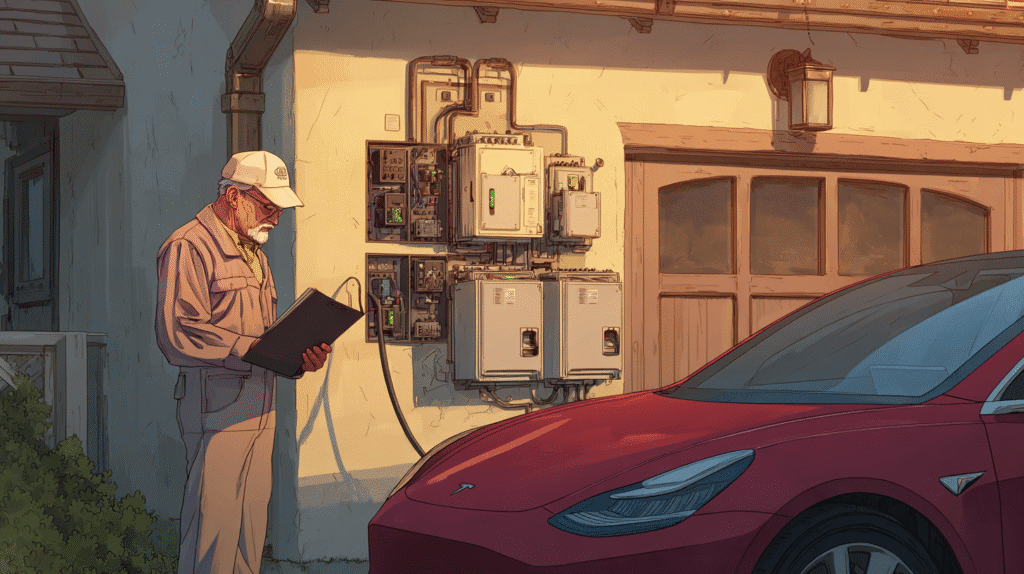
Before you buy or install a charger, it’s crucial to assess whether your home’s electrical system can handle the extra load. This evaluation forms the foundation of your entire installation project and will determine both your charger options and potential upgrade costs.
Check Your Main Panel Capacity
Most homes have either a 100-amp or 200-amp electrical panel, though older homes might have as little as 60 amps. Your panel’s capacity determines how much electrical load your home can safely handle.
A Level 2 EV charger requires a 240-volt circuit, drawing between 20–50 amps, depending on the model. The National Electrical Code (NEC) requires that continuous loads like EV chargers use no more than 80% of a circuit’s rated capacity. This means a 40-amp charger needs a 50-amp breaker, and a 48-amp charger requires a 60-amp breaker.
To determine if your panel has adequate capacity, you’ll need to calculate your current electrical load. Add up the amperage of all existing circuits, then subtract this from your panel’s total capacity. If you have less than 50 amps of spare capacity, you may need to consider either a lower-amperage charger or a panel upgrade.
Understanding Load Management Solutions
If your panel is near capacity, don’t assume you automatically need an expensive upgrade. Several load management solutions can help you add EV charging without replacing your entire electrical service:
Load sharing devices monitor your home’s total electrical usage and automatically reduce charging speed when other major appliances are running. These smart systems can save thousands compared to a full panel upgrade while still providing reliable charging.
Sub-panels and circuit splitting allow you to reorganize your electrical distribution more efficiently. An electrician might be able to consolidate circuits or move non-essential loads to create space for your EV charger.
Smart panels and energy management systems represent the latest technology in home electrical distribution. Companies like Span and Lumin offer intelligent panels that dynamically manage electrical loads, ensuring your EV charges without overloading your system.
Signs Your Electrical System Needs Attention
Beyond simple capacity calculations, several warning signs indicate your electrical system might need upgrading before EV charger installation:
- Flickering lights when major appliances turn on
- Frequent breaker trips under normal usage
- Warm outlet covers or burning smells near the panel
- Aluminum wiring (common in homes built 1965-1973)
- Federal Pacific or Zinsco panels (known fire hazards)
- Lack of proper grounding or GFCI protection
Pro Tip: Ask a licensed electrician to perform a comprehensive load calculation and panel inspection. This typically costs $200-$400 but can save thousands by identifying the most cost-effective installation approach.
Step 2: Choose the Right Charger for Your Needs
Not all chargers are the same. The right choice depends on your driving habits, home setup, vehicle compatibility, and future plans. Understanding the nuances between different charger types ensures you make an investment that serves you well for years to come.
Level 1 vs. Level 2: Understanding the Difference
Level 1 charging uses a standard 120V outlet and typically adds 3-5 miles of range per hour of charging. While this comes standard with every EV and requires no installation, it’s only practical for drivers who:
- Drive less than 30 miles per day
- Have consistent overnight parking
- Can supplement with workplace charging
- Own a plug-in hybrid with smaller batteries
Level 2 charging operates on 240V power and delivers 12-60 miles of range per hour, depending on the charger’s amperage and your vehicle’s onboard charger capacity. This is the sweet spot for home charging because it:
- Fully charges most EVs overnight (4-8 hours)
- Supports all current and future EV models
- Enables convenient daily driving without range anxiety
- Increases home value more than Level 1 outlets
Smart Chargers vs. Basic Units
The decision between smart and basic chargers impacts both functionality and long-term value:
Smart chargers ($500-$1,200) offer advanced features including:
- Scheduled charging to take advantage of time-of-use electricity rates
- Energy monitoring to track costs and environmental impact
- Load balancing to prevent overloading your electrical system
- Remote control via smartphone apps for starting, stopping, and monitoring sessions
- Integration with solar systems and home automation platforms
- Access control to prevent unauthorized use
- Over-the-air updates for new features and improvements
Basic chargers ($300-$600) provide reliable charging without the bells and whistles. They’re ideal for:
- Budget-conscious buyers
- Simple charging needs
- Renters who may move the unit
- Areas with flat electricity rates
- Users who prefer mechanical simplicity
Amperage Considerations and Future-Proofing
Selecting the right amperage rating requires balancing current needs with future considerations:
32-amp chargers work well for most current EVs and smaller battery packs. They add about 25 miles of range per hour and only require a 40-amp circuit breaker.
40-amp chargers represent the sweet spot for many homeowners, adding 30-35 miles per hour while remaining compatible with most electrical panels.
48-amp chargers maximize charging speed for vehicles with larger batteries or higher-capacity onboard chargers. They’re ideal for:
- Households with multiple EVs
- Drivers with long daily commutes
- Future electric trucks and SUVs
- Maximizing solar energy capture
Pro Tip: Choose a charger rated for at least 32 amps, even if your current vehicle charges slower. Future EVs will likely have larger batteries and faster onboard chargers, making higher-amperage home stations more valuable.
Step 3: Navigate Permits and Local Requirements
Before starting installation, most cities and utility companies require you to obtain proper permits. This bureaucratic step might seem tedious, but it ensures your setup meets local building codes and safety standards while protecting your home’s insurance coverage and resale value.
Understanding Permit Requirements
Electrical permits for EV charger installation typically fall into two categories:
Standard electrical permits cover the installation of new circuits and outlets. These are required in virtually all jurisdictions and usually cost $50-$200. The permit ensures your installation meets the National Electrical Code (NEC) and local amendments.
EV-specific permits are required in some areas with high EV adoption or special utility programs. These might include additional requirements for:
- Load calculations showing your home can handle the additional demand
- Proof of dedicated metering for EV charging incentives
- Compliance with local fire codes for garage installations
- Coordination with utility demand response programs
Documentation You’ll Need
When applying for permits, be prepared to provide:
Electrical load calculations showing your panel’s current usage and available capacity. This demonstrates your home can safely support the additional load without creating hazards.
Site plans indicating where the charger will be installed relative to your electrical panel, parking area, and property lines. Some jurisdictions require specific clearances from doors, windows, and property boundaries.
Product specifications for your chosen charger, including UL listing numbers, amperage ratings, and installation manuals. Approved equipment lists vary by jurisdiction.
Contractor information including license numbers, insurance certificates, and bond information. Many areas require that only licensed electricians perform 240V installations.
Working with Your Utility Company
Beyond local permits, many utilities require notification or approval before installing EV charging equipment:
Rate plan changes might be necessary to access special EV charging rates. Some utilities offer time-of-use plans that can reduce charging costs by 50% or more during off-peak hours.
Transformer assessments help utilities plan for increased neighborhood electrical demand. In areas with high EV adoption, utilities might need to upgrade local infrastructure.
Demand response enrollment allows your utility to occasionally reduce charging speeds during peak demand periods in exchange for bill credits or rebates.
Pro Tip: Many electricians handle the entire permitting process as part of their installation service. Always confirm this upfront and ensure permit costs are clearly itemized in your estimate.
Step 4: Hire a Licensed Electrician
Installing a 240V circuit and charger is not a DIY project—it requires professional expertise, specialized tools, and deep knowledge of electrical codes. Choosing the right electrician can mean the difference between a smooth installation and costly problems down the road.
Finding Qualified EV Charger Installers
Not all electricians have experience with EV charger installations. Look for professionals who:
Specialize in EV charging or have completed manufacturer training programs. Many charger companies maintain lists of certified installers.
Understand load management solutions and can recommend alternatives to expensive panel upgrades when appropriate.
Stay current with codes specific to EV charging, which have evolved rapidly as the technology has matured.
Offer comprehensive services including permit pulling, utility coordination, and post-installation support.
What to Expect During Installation
A professional installation typically takes 2-6 hours, depending on complexity:
Initial assessment (30-60 minutes): The electrician inspects your panel, confirms capacity, and reviews the installation path from panel to charger location.
Circuit installation (1-3 hours): This involves installing a new breaker, running appropriate gauge wire through conduit or walls, and ensuring proper grounding. The distance from panel to charger significantly impacts installation time and cost.
Charger mounting (30-60 minutes): The unit is securely attached to your wall or pedestal mount, with careful attention to height and accessibility requirements.
Connection and testing (30 minutes): All connections are torqued to specification, and the system is tested for proper voltage, grounding, and GFCI function if required.
Final documentation: The electrician should provide documentation of the installation, including circuit specifications, test results, and warranty information.
Installation Cost Breakdown
Understanding typical costs helps you budget appropriately and identify fair pricing:
Basic installation ($500-$1,500): Covers installations within 25 feet of the panel with straightforward wall mounting and no significant obstacles.
Standard installation ($1,500-$3,000): Includes longer wire runs, exterior wall penetrations, or minor panel modifications.
Complex installation ($3,000-$5,000+): Required for panel upgrades, underground conduit runs, or installations requiring extensive construction work.
Additional costs might include:
- Permits: $50-$500
- Panel upgrades: $1,500-$3,500
- Trenching for underground wire: $10-$25 per foot
- Smart load management devices: $500-$1,500
- Concrete work for pedestal mounting: $200-$500
Pro Tip: Get at least three detailed estimates that itemize labor, materials, and permits. Beware of quotes that seem too good to be true—they often exclude necessary work that appears as “change orders” later.
Step 5: Plan for Optimal Charger Placement
Where you install your charger affects both daily convenience and long-term usability. Strategic placement can save installation costs, improve accessibility, and accommodate future needs.
Indoor vs. Outdoor Installation
Garage installations offer maximum convenience and protection from weather. Mount the charger on the wall closest to where you park, typically 3-4 feet above the floor. Consider:
- Proximity to the driver’s side charging port
- Clearance for walking around the vehicle
- Protection from car doors and shopping bags
- Adequate ventilation if required by local codes
Outdoor installations work well for carports, driveways, or homes without garages. Choose equipment rated for outdoor use (NEMA 3R or 4X) and consider:
- Protection from direct sunlight to prevent overheating
- Height above potential snow accumulation
- Security features to prevent unauthorized use
- Weatherproof enclosures for plugs and connections
Cable Management Strategies
Proper cable management improves safety and extends equipment life:
Wall-mounted cable organizers keep charging cables off the ground and prevent tangling. Look for retractable systems that automatically manage cable slack.
Overhead cable systems work well in garages with high ceilings, suspending the cable above vehicle height when not in use.
Pedestal mounting positions the charger between parking spaces, ideal for households with multiple EVs or frequently changing parking arrangements.
Planning for Future Expansion
Consider these forward-thinking strategies:
Install larger conduit than currently needed to facilitate future wire upgrades without demolition.
Add a sub-panel near your parking area to simplify adding additional chargers later.
Pre-wire for second chargers if you anticipate adding another EV within 3-5 years.
Consider bi-directional charging readiness as vehicle-to-home technology becomes more common.
Pro Tip: Install your charger at least 18 inches from corners and 36 inches from doors to meet most accessibility requirements and ensure comfortable use regardless of vehicle size.
Step 6: Navigate the Inspection Process
Once installation is complete, your city or county typically requires a final inspection before you can legally use the charger. This critical step validates that your installation meets all safety codes and regulations.
Preparing for Inspection
Before the inspector arrives, ensure:
All work is complete including panel labeling, ground fault protection, and proper cable management.
Documentation is ready including permits, product specifications, and any load calculations performed.
Access is clear to both the electrical panel and charger location, with adequate lighting for inspection.
The system is energized and ready for testing, with your EV available if the inspector wants to verify actual charging operation.
What Inspectors Check
Inspectors typically verify:
Proper wire gauge for the circuit amperage and length of run Correct breaker sizing following the 125% rule for continuous loads Adequate grounding including equipment grounding and GFCI protection where required Proper labeling of circuits at both the panel and disconnect location Code compliance for mounting height, working clearances, and environmental protection Load calculations confirming your panel can safely handle the additional demand
Common Inspection Issues and Solutions
Understanding frequent failure points helps ensure you pass on the first attempt:
Incorrect torque specifications on electrical connections can cause failures. Ensure your electrician uses a torque wrench and follows manufacturer specifications.
Missing or incorrect signage such as emergency shutdown labels or circuit identification can delay approval.
Improper GFCI protection is increasingly required for EV charging circuits. Ensure your installation follows the latest NEC requirements.
Inadequate working space around equipment must meet code minimums for safe operation and maintenance.
Pro Tip: Schedule your inspection early in the week to allow time for any corrections before the weekend. Many jurisdictions offer same-week reinspection if minor issues need addressing.
Step 7: Set Up and Optimize Your Charging System
After passing inspection, it’s time to configure your charging station for optimal performance and cost savings. Modern smart chargers offer numerous features that can significantly reduce charging costs and improve convenience.
Initial Configuration and Testing
Start with these essential setup steps:
Download the manufacturer’s app and create an account. Most smart chargers require app registration for warranty activation and feature access.
Connect to your Wi-Fi network using the 2.4GHz band, as many chargers don’t support 5GHz connections. Ensure strong signal strength at the charger location.
Update firmware immediately to access the latest features and security patches. Enable automatic updates if available.
Configure user preferences including:
- Notification settings for charging completion
- Access control via RFID cards or app authentication
- Display brightness and sleep settings
- Alert preferences for charging interruptions
Maximizing Time-of-Use Savings
Strategic charging schedules can reduce electricity costs by 50% or more:
Identify your utility’s rate schedule including peak, off-peak, and super off-peak periods. Many utilities offer rates as low as $0.05/kWh overnight.
Program charging windows to start after 11 PM or during your utility’s cheapest rate period. Most EVs can be programmed to only accept charge during these windows.
Set charge limits if you don’t need a full charge daily. Charging to 80% can extend battery life while meeting most daily driving needs.
Enable smart charging features that automatically optimize charging based on your schedule, electricity rates, and grid conditions.
Integration with Home Energy Systems
Modern EV chargers can work seamlessly with other home energy technologies:
Solar integration allows you to charge primarily with excess solar production, maximizing renewable energy use and minimizing grid dependence.
Home battery coordination ensures your EV and home battery system work together efficiently, preventing conflicts during power outages or peak rate periods.
Smart home platforms like Amazon Alexa or Google Home can provide voice control and automation capabilities.
Energy monitoring systems help track your home’s total energy use and identify opportunities for additional savings.
Pro Tip: Many utilities offer demand response programs that pay you for allowing temporary charging reductions during grid emergencies. Enrollment is usually free and can earn $50-$200 annually.
Step 8: Understanding Costs and Financial Incentives
The total cost of home charging installation varies widely, but numerous incentives can offset expenses while long-term savings justify the investment.
Comprehensive Cost Analysis
Understanding true costs helps you budget appropriately:
Equipment costs range from $300-$1,500 depending on features and amperage ratings. Smart chargers with higher amperage cost more but offer better long-term value.
Installation expenses typically run $500-$3,000 for standard installations, with complex scenarios potentially exceeding $5,000.
Ongoing operational costs are minimal, adding $30-$50 monthly to your electric bill for average drivers (12,000 miles/year).
Maintenance expenses are virtually zero for quality equipment, though outdoor installations may need occasional cleaning.
Federal and State Incentives
Multiple incentive programs can reduce installation costs:
Federal tax credits through the Alternative Fuel Vehicle Refueling Property Credit cover 30% of installation costs up to $1,000 for residential installations.
State rebates vary significantly, with some states offering up to $2,000 for home charger installation. California, New York, and Massachusetts lead in generous incentive programs.
Utility programs often provide additional rebates of $200-$800, plus reduced electricity rates for EV charging.
Local incentives from cities or air quality management districts can stack with other programs for maximum savings.
Calculating Return on Investment
Home charging typically pays for itself within 2-3 years:
Annual fuel savings of $1,000-$1,500 compared to gasoline vehicles Public charging avoidance saves $500-$1,000 yearly versus exclusive public charging use Time savings valued at 50+ hours annually not visiting gas stations or public chargers Home value increase of $1,000-$3,000 according to recent real estate studies
Step 9: Troubleshooting Common Issues
Even properly installed charging systems occasionally experience problems. Understanding common issues and solutions helps minimize downtime and avoid unnecessary service calls.
Charging Interruptions and Failures
When charging unexpectedly stops or won’t start:
Check your vehicle’s charge settings including scheduled charging, charge limits, and location-based preferences that might prevent immediate charging.
Verify the charging cable connection at both the vehicle and charger ends. Dirty or corroded contacts can prevent proper communication.
Inspect your electrical panel for tripped breakers or GFCI outlets. Ground faults from moisture or damaged cables commonly cause charging interruptions.
Review your charger’s error codes through indicator lights or app notifications. Most issues involve simple fixes like power cycling the unit.
Slow Charging Speeds
If charging seems slower than expected:
Confirm your vehicle’s maximum charge rate as many EVs limit home charging to 32 amps regardless of charger capacity.
Check temperature conditions since extreme cold or heat can reduce charging speeds by 25% or more as the battery management system protects cells.
Verify voltage levels using the charger’s app or display. Low voltage (under 240V) reduces charging power proportionally.
Evaluate load management settings that might be limiting charging to prevent overloading your electrical system.
Network and Connectivity Problems
For smart chargers experiencing connection issues:
Restart your router and charger to reset network connections. Many connectivity issues resolve with simple power cycling.
Verify Wi-Fi signal strength at the charger location. Metal garage doors and distance from routers commonly cause weak signals.
Check for firmware updates manually if automatic updates aren’t working. Manufacturers regularly release patches for connectivity issues.
Consider network alternatives like cellular modules or powerline adapters if Wi-Fi remains unreliable.
Pro Tip: Keep a charging log for the first month to identify patterns in any issues. This data helps electricians or manufacturers quickly diagnose persistent problems.
Step 10: Maintenance and Long-Term Care
While EV chargers require minimal maintenance, regular care extends equipment life and ensures reliable operation for years to come.
Routine Maintenance Tasks
Monthly visual inspections should check for:
- Physical damage to cables or connectors
- Debris accumulation in connector holsters
- Signs of overheating or discoloration
- Proper cable management and strain relief
Quarterly cleaning keeps equipment functioning optimally:
- Clean charging connectors with electrical contact cleaner
- Remove dust and debris from ventilation areas
- Check and tighten any loose mounting hardware
- Test GFCI outlets and breakers
Annual professional inspection by your electrician should verify:
- Electrical connections remain properly torqued
- Grounding systems maintain continuity
- Breaker and wire sizing still meet requirements
- Weather sealing remains intact for outdoor units
Extending Equipment Lifespan
Protect your investment with these practices:
Avoid cable stress by properly supporting the weight during charging and storing cables without sharp bends or kinks.
Manage temperature extremes by providing shade for outdoor units in hot climates and ensuring adequate ventilation.
Prevent physical damage by installing protective bollards or wheel stops if vehicles could impact the charger.
Update software regularly to maintain security and access new features that improve charging efficiency.
When to Consider Upgrades
Technology advances may warrant upgrading your charging equipment:
Bi-directional charging capability enables vehicle-to-home backup power Higher charging speeds become valuable when upgrading to EVs with larger batteries Enhanced smart features improve integration with home energy management Warranty expiration after 5-10 years might justify replacement with newer technology
Regional Considerations and Climate Factors
Installation requirements and best practices vary significantly based on geographic location and local climate conditions.
Cold Climate Installations
Northern regions require special considerations:
Cable flexibility becomes critical as standard cables stiffen below freezing. Consider heated cable options or indoor storage systems.
Snow and ice management needs planning for both charger access and cable routing. Install units higher than typical snow accumulation levels.
Heating elements in some chargers prevent internal condensation and maintain optimal operating temperatures.
Garage heating impacts should be considered, as EV batteries charge more efficiently in moderate temperatures.
Hot Climate Adaptations
Desert and tropical regions present unique challenges:
Heat dissipation becomes critical for chargers in direct sunlight. Install shade structures or choose locations with afternoon shade.
Dust protection requires sealed units (NEMA 4X rating) and regular cleaning of ventilation systems.
Surge protection gains importance in areas with frequent thunderstorms. Install whole-home surge protectors in addition to charger-specific protection.
Peak demand management helps avoid charging during the hottest parts of the day when grid stress is highest.
Coastal Installation Requirements
Properties near oceans need additional protection:
Corrosion resistance requires stainless steel or specially coated equipment to withstand salt air.
Enhanced grounding protects against electrical issues from moisture and salt accumulation.
Elevated mounting prevents flood damage in hurricane-prone areas.
Regular maintenance becomes more critical to remove salt deposits and check for corrosion.
Future-Proofing Your Installation
Technology evolves rapidly in the EV space. Installing with future needs in mind protects your investment and avoids costly retrofits.
Emerging Technologies to Consider
Vehicle-to-Grid (V2G) capabilities will allow EVs to sell power back to utilities during peak demand periods.
Wireless charging systems may eventually eliminate cables entirely for compatible vehicles.
DC fast charging costs are dropping, potentially making home DC charging viable for some users.
Automated charging robots could handle the entire charging process without human intervention.
Building for Tomorrow’s Needs
Install excess capacity by running larger conduit and higher-gauge wire than currently needed.
Choose modular systems that allow upgrading components without complete replacement.
Document everything including wire routes, panel capacity calculations, and equipment specifications for future reference.
Maintain upgrade pathways by avoiding permanent obstacles to future electrical work.
Safety Best Practices and Code Compliance
Safety should remain paramount throughout installation and operation of your home charging system.
Essential Safety Features
Ground Fault Circuit Interruption (GFCI) protection is increasingly required by code and provides critical protection against electrical shock.
Proper grounding includes both equipment grounding and system grounding to safely dissipate electrical faults.
Overcurrent protection through properly sized breakers prevents wire overheating and potential fires.
Physical protection guards against vehicle impact, lawn equipment, and weather-related damage.
Code Evolution and Compliance
The National Electrical Code updates every three years with new EV charging requirements:
2020 NEC introduced GFCI requirements for many EV charging installations 2023 NEC added energy management requirements and updated grounding specifications Local amendments often add requirements beyond national codes
Stay informed about code changes that might affect future installations or require updates to existing systems.
Conclusion
Installing a home EV charger represents more than just adding an electrical outlet—it’s an investment in convenient, cost-effective, and sustainable transportation. By following this comprehensive guide, you’ll navigate the installation process confidently, from initial planning through long-term maintenance.
The key to successful installation lies in proper planning, professional execution, and strategic optimization. Take time to evaluate your electrical system thoroughly, choose equipment that meets both current and future needs, and work with qualified professionals who understand the unique requirements of EV charging installations.
Remember that while the upfront investment might seem significant, the long-term benefits far outweigh the costs. Between fuel savings, convenience gains, and available incentives, most installations pay for themselves within just a few years. More importantly, you’ll enjoy the daily convenience of starting each day with a fully charged vehicle, ready for whatever journey lies ahead.
As electric vehicle adoption accelerates and technology continues advancing, having a properly installed home charging system positions you at the forefront of the transportation revolution. Whether you’re charging a compact sedan today or an electric pickup truck tomorrow, your home charging station will serve as the foundation of your electric driving experience for years to come.