Table of Contents
Level 1 vs Level 2 EV Charging: Complete Consumer Guide
Installing a home EV charger delivers immediate benefits. Most drivers save $1,000-$1,500 annually on fuel while cutting charging time from 40+ hours to just 4-8 hours for a full battery. With federal tax credits covering 30% of installation costs (up to $1,000) and Level 2 charging paying for itself within 1-3 years, the economics are compelling. This guide provides specific costs, real charging speeds for popular EVs, and practical solutions for every home situation in 2025.
Home charging accounts for over 80% of EV charging sessions, making it the cornerstone of EV ownership. While Level 1 charging (120V standard outlet) works for light use, Level 2 (240V) transforms the experience by delivering 5-10x faster charging speeds. The choice between them impacts daily convenience, total ownership costs, and whether an EV fits your lifestyle. Here’s everything you need to make an informed decision based on current 2025 data, real-world costs, and proven solutions.
Charging speeds unlock daily convenience
Level 1 charging delivers 3-4 miles of range per hour using a standard 120V outlet at 1.2-1.9 kW. For a Tesla Model 3 Long Range with 75 kWh battery, expect 40-50+ hours for a complete charge from empty. This works for drivers covering under 30 miles daily who can charge overnight, but leaves little margin for unexpected trips or multiple days without charging.
Level 2 charging transforms this equation entirely. At 32A (7.68 kW), the most common residential setup, you’ll add 17-26 miles per hour—enough to fully charge that same Tesla in 8-10 hours overnight. Step up to 48A (11.5 kW), and charging speeds reach 30-44 miles per hour, completing most daily charging in just 4-6 hours. The Tesla Model Y charges at similar speeds, while the Chevy Bolt EUV with its 65 kWh battery and 11.5 kW onboard charger adds 37-39 miles per hour at 48A, completing a full charge in roughly 7 hours.
Trucks and larger SUVs showcase Level 2’s value most clearly. The Ford F-150 Lightning Extended Range carries a massive 123 kWh battery—at Level 1, charging would take multiple days. At 48A Level 2, it charges completely overnight in 12 hours. The Rivian R1T with Max Pack (141.5 kWh) similarly needs robust home charging, completing a full charge in 13.5 hours at 48A versus an impractical 4+ days on Level 1.
Vehicle onboard chargers set the maximum charging speed regardless of your equipment. Most modern EVs accept 11-11.5 kW (48A), making this the optimal home charging power level for 2025. The Nissan Leaf accepts only 6.6 kW (28A), so upgrading beyond 32A provides no benefit. The Hyundai Ioniq 5 and VW ID.4 both max out at 11 kW onboard charging, benefiting fully from 48A installations.
Cold weather significantly impacts charging speeds. Below 40°F, charging can take 2-3x longer without battery preconditioning as lithium-ion chemistry slows down. Most modern EVs include automatic preconditioning when scheduled in the vehicle app—start this process 20-30 minutes before plugging in for optimal charging speed. The Tesla Model 3/Y heat pump system and Hyundai Ioniq 5’s battery warming maintain near-normal range even in freezing temperatures, while vehicles without active thermal management lose 20-30% range in winter.
Installation costs vary dramatically by home setup
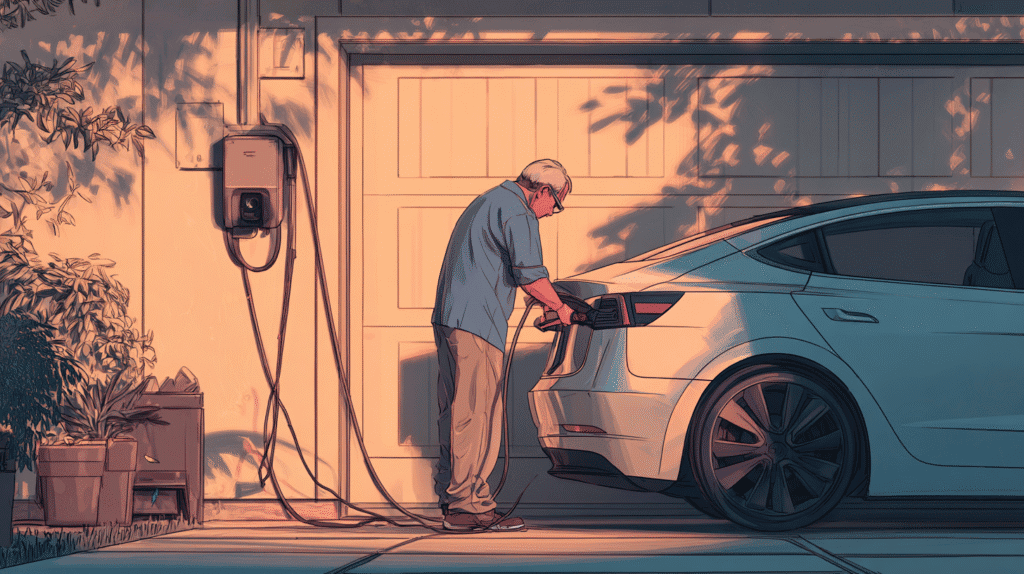
A basic Level 2 installation in a home with existing electrical capacity costs $1,000-$1,500 total in 2025—$400-$650 for a quality smart charger plus $500-$900 in labor and materials. This assumes your electrical panel sits within 30 feet of your parking area and has sufficient capacity. The Emporia Classic at $400-$450 provides full smart features including WiFi control, energy monitoring, and 48A charging, making it exceptional value. The Grizzl-E Classic at $350-$400 offers rugged NEMA 4 weatherproofing without smart features.
Installation complexity drives costs sharply upward. A 50-foot wire run adds $600-$1,400 in materials and labor at $10-$20 per foot installed, while 100+ foot runs can exceed $2,000 just for wiring. If trenching is required for underground conduit, budget $10-$20 per foot for standard soil or $25-$100 per foot for rock or difficult terrain. A detached garage 75 feet from your electrical panel could easily reach $2,500-$4,000 for complete installation.
Electrical panel upgrades represent the largest potential cost. Homes with 60-100A service near capacity need upgrades to 200A service, costing $1,300-$3,000 nationally for the panel work itself. Regional variations are substantial—expect $2,500-$4,000 in California and major metro areas versus $1,200-$2,000 in Texas and the Midwest. Include additional wiring from the utility line if needed, potentially adding $500-$2,000 more.
The 125% rule determines if you need an upgrade. Your EV charger draws continuous load, so it requires a dedicated breaker sized at 125% of the charger’s rating—a 40A charger needs a 50A breaker. If your existing panel cannot accommodate this new 50-60A circuit while maintaining 80% total capacity rule, upgrade becomes necessary. A professional load calculation costs $100-$200 and prevents expensive mistakes.
Smart load management systems bypass expensive panel upgrades. The Emporia Pro with Vue 3 monitor ($600-$700) dynamically adjusts charging power based on whole-home electrical usage, preventing overloads on 100A panels. NeoCharge Smart Splitter ($399) shares a dryer’s 240V outlet between the appliance and EV charger, automatically switching between them—when your dryer runs, EV charging pauses. These solutions save $1,500-$3,000 compared to panel upgrades.
Regional electrician rates create 2-3x cost differences. California Bay Area and New York City charge $100-$150/hour for licensed electricians, while Midwest rates run $50-$80/hour. A standard 5-hour installation costs $375 in Indianapolis versus $750 in San Francisco before materials. Permits add $50-$200 in most areas but can reach $300-$500 in major cities with complex inspection requirements.
Hardwired installations often cost less than plug-in setups despite seeming more permanent. A hardwired 48A charger avoids the $100-$250 GFCI breaker required by NEC 2023 for plug-in installations in garages, and eliminates the $50-$100 outlet expense. Total savings of $150-$350 frequently make hardwired the most economical choice while enabling faster 48A charging versus the 40A limit on standard NEMA 14-50 outlets.
Federal and state incentives cut net costs substantially
The federal Alternative Fuel Infrastructure Tax Credit provides 30% of installation costs up to $1,000 maximum through December 31, 2032. This applies to both equipment and professional installation labor—a $1,500 total installation nets you $450 back when filing your taxes. Claim it using IRS Form 8911 when filing. The credit applies only to primary residences, not rental properties or second homes, and requires keeping all receipts from licensed contractors.
California leads state incentive programs with multiple utility-specific rebates. Southern California Edison offers up to $4,200 for residential EV charger installations through various programs including income-qualified options reaching $2,000-$4,200. PG&E provides $500-$1,500 depending on charger features and installation type. LADWP offers $500-$1,000 for smart chargers capable of managed charging. These California programs require Energy Star certification and often mandate using approved contractor lists.
Other high-value state programs include Colorado utilities offering $500-$1,300 in combined incentives, Illinois providing up to $1,000 (increasing to $2,000 after June 1, 2025), and Washington State (Puget Sound Energy) giving $500+ for standard installations plus up to $2,000 additional for income-qualified customers. Most programs require Energy Star certified chargers, WiFi capability for smart charging, and licensed electrician installation.
Time-of-use (TOU) electricity rates deliver ongoing savings exceeding one-time rebates. California utilities offer super off-peak rates (midnight-6am) at 25-33¢/kWh versus 60-74¢/kWh on-peak (4-9pm)—a 60%+ difference. Charging a 60 kWh battery at off-peak rates costs $15-20 versus $36-45 at peak rates, saving $20-25 per charge. For drivers charging 50 times annually, this delivers $1,000-$1,250 in annual savings, effectively paying for the charger installation in 1-2 years.
Smart chargers maximize TOU savings automatically. The ChargePoint Home Flex ($549-$649), JuiceBox 40 ($599), and Wallbox Pulsar Plus ($400-$549) all include scheduling features that trigger charging during utility off-peak windows. Set your target departure time, and the charger calculates when to start based on battery level and charge rate needed. This hands-off approach captures maximum savings without daily management.
Stacking incentives dramatically reduces net costs. A California homeowner installing a $1,500 system receives:
- Federal tax credit: $450 (30% of $1,500)
- SCE utility rebate: $1,000 (standard program)
- Installation tax deduction: Various local programs
Net cost: $50-$500 depending on local programs. Even in states with minimal rebates, the federal credit brings most installations under $1,000 after incentives.
Smart charger features justify modest price premiums
The Emporia Classic ($400-$450) dominates the value category in 2025. It delivers adjustable 48A/40A charging with complete WiFi app control, real-time energy monitoring showing exact costs, flexible scheduling for TOU optimization, and Alexa integration. Its Energy Star certification qualifies for most utility rebates. Named “Best Level 2 EV Charger” by MotorTrend, InsideEVs, and Car Talk, it offers premium features at mid-range pricing. The 25-foot cable reaches most home parking configurations.
For households without smart features needs, the Grizzl-E Classic ($350-$400) provides exceptional rugged reliability. Its adjustable 16/24/32/40A output via DIP switches handles any vehicle, while the metal NEMA 4, IP67 enclosure withstands extreme weather. The 3-year warranty (5-year for $100 more) and Canadian manufacturing ensure durability. It lacks WiFi entirely—a pure plug-and-charge solution that never needs firmware updates or troubleshooting connectivity.
The ChargePoint Home Flex ($549-$649) justifies its premium pricing for the eco-system conscious. Beyond standard smart features, it provides app-adjustable amperage from 16-50A without opening the unit, swappable cables converting between J1772 and NACS connectors (future-proofing for $100 cable swap), and integration with ChargePoint’s 31,000+ public charging locations in a single app. The ability to adjust power output suits changing vehicles or electrical situations without replacing hardware.
Tesla Wall Connector ($450) and Tesla Universal Wall Connector ($595-$650) serve distinct audiences. The standard version works only with Tesla vehicles but integrates perfectly with the Tesla app, enables power sharing between multiple Wall Connectors on one circuit (critical for two-Tesla households), and provides 48A charging with simple installation. The Universal version adds a built-in J1772 adapter making it compatible with all EVs while maintaining Tesla’s 4-year warranty and reliability reputation.
Load balancing features prevent expensive electrical upgrades in multi-EV households. JuiceBox 40/48 ($599-$750) and Tesla Wall Connectors support power sharing, automatically dividing available power between multiple chargers based on need. The Emporia Pro ($600-$700 with Vue monitor) goes further with whole-home dynamic load balancing, reducing EV charging power when your home approaches panel capacity—running your dryer while cooking won’t trip breakers or require upgrades.
OCPP compatibility ensures long-term flexibility. The Grizzl-E Smart ($380-$450) and Wallbox Pulsar Plus ($400-$549) support OCPP 1.6, allowing you to switch monitoring apps (AmpUp, ChargeLab, etc.) instead of locking into a single manufacturer’s ecosystem. As utility demand response programs expand, OCPP chargers participate regardless of which utility program emerges in your area.
Energy monitoring granularity varies significantly. Basic chargers show only total session energy. The Emporia line provides real-time power draw, cost per session, monthly trends, and circuit-level home energy data when paired with the Vue monitor. This visibility helps optimize charging schedules, calculate actual driving costs versus gasoline, and identify other home energy waste worth addressing.
Premium chargers rarely justify their $800-$1,200+ pricing for residential use. The ChargePoint Home Flex at $649 represents the ceiling of value, while chargers exceeding $800 typically add commercial-grade features like RFID access control, payment processing, or higher IP ratings that residential users don’t need. Better to invest $400-$650 in a quality residential charger and put savings toward electrical upgrades if needed.
Electrical requirements determine installation complexity
The NEC 125% rule governs all EV charging installations. Because chargers run continuously for 3+ hours, they’re classified as continuous loads requiring breakers sized at 125% of maximum amperage. A 40A charger needs a 50A breaker, a 48A charger requires a 60A breaker, and an 80A charger demands a 100A breaker. This dedicated circuit can have no other outlets or devices—the EV charger alone.
Wire gauge requirements follow NEC Table 310.16 strictly. A 50A breaker needs 6 AWG copper wire, while a 60A breaker requires 6 AWG copper for runs under 75 feet or 4 AWG for longer distances to prevent voltage drop. An 80A circuit demands 3 AWG copper. Using aluminum wire requires upsizing by approximately two gauges—consult a licensed electrician as improper connections cause fires. Modern installations use THHN/THWN-2 copper wire rated for 75-90°C.
GFCI requirements from NEC 2023 add $100-$250 to plug-in installations. All receptacles for EV charging require GFCI protection regardless of location—garage, outdoor, basement. This means either a GFCI breaker in the main panel ($150-$250) or a GFCI-protected outlet ($100-$200 installed). However, hardwired installations exceeding 50A are exempt from GFCI requirements, one reason 48A hardwired installations often cost less than 40A plug-in setups.
Outdoor installations require proper weatherproofing. Minimum NEMA 3R rating provides rain and snow protection for $50-$150 in basic enclosures, suitable for covered parking areas. NEMA 4 ratings ($100-$300) add hose-directed water resistance and dust-tight sealing. NEMA 4X ($150-$400) uses corrosion-resistant materials critical within 10 miles of saltwater coastlines where standard metals corrode rapidly. Most quality EV chargers include NEMA 4 or better enclosures.
Proper mounting and cord management prevent wear and safety issues. Install chargers at 24 inches above grade for outdoor locations or 18 inches above floor for indoor garages, keeping the outlet accessible but protected from vehicle strikes. Use 25-foot cables (the NEC maximum) for maximum flexibility in parking multiple vehicles or future vehicle changes—different EV models place charge ports on different sides and locations.
Never use extension cords with EV chargers. This violates NEC code, creates fire hazards from resistance heating at connection points, and voids warranties. Extension cords aren’t rated for continuous 40-48A loads over hours. If your charger won’t reach your vehicle, relocate the charger or install a new circuit closer to your parking spot. Even “heavy-duty” extension cords cause measurable voltage drop, reducing charging efficiency and potentially damaging vehicle charging systems.
Load calculations determine if your panel can support a charger. A 200A panel at 80% capacity provides 160A safely. Subtract your existing load (typically 80-100A for a modern home with electric appliances) to find available capacity. A 48A EV circuit (60A breaker) fits comfortably. A 100A panel at 80% provides just 80A—with typical 60-70A existing load, only 10-20A remains available, necessitating either a panel upgrade or load management solutions.
Real-world costs show clear value proposition
Level 2 installation costs $1,500 on average including a quality smart charger and professional installation. At national average electricity rates of $0.17/kWh, charging an efficient EV costs $0.05/mile versus $0.10-$0.12/mile for a 30 MPG gasoline vehicle at current prices. For 15,000 annual miles, that’s $750/year for electricity versus $1,580/year for gas—an $830 annual saving.
Time-of-use rates amplify savings. California residents on super off-peak plans pay $0.25-$0.30/kWh for night charging versus standard rates of $0.31-$0.35/kWh, reducing annual charging costs from $1,353 to $950, saving an additional $400 annually. Over a 5-year vehicle ownership, TOU optimization saves $2,000+ beyond gasoline cost savings.
Payback calculations accounting only for financial factors show 2-3 year payback for average drivers:
- Installation: $1,500 – $450 federal credit = $1,050 net
- Annual gas savings: $830/year
- TOU savings: $200/year additional
- Total savings: $1,030/year
- Payback: 1.0 years
Add convenience value and payback becomes immediate. The 1,500 hours annually saved versus Level 1 charging (6 hours per charge × 250 charges) has economic value exceeding installation costs at any reasonable hourly rate.
Multi-vehicle households double the value proposition. Two EVs driving 30,000 combined miles save $2,200 annually versus gasoline. A $4,000 investment in two chargers with load management (avoiding panel upgrades) pays back in 1.8 years through fuel savings alone. The Grizzl-E Duo ($850-$1,000) provides dual 40A charging from a single circuit, ideal for families with two EVs and limited electrical capacity.
Solar integration transforms EVs from cost savers to cost eliminators. A 10 kW solar system sized for home plus one EV costs $20,000 net after the 30% federal solar tax credit. At $0.16/kWh, it generates $2,080 worth of electricity annually (13,000 kWh), paying for itself in 9.6 years. Marginal cost of charging becomes zero—you’re driving on sunshine. The Wallbox Pulsar Plus with power meter ($749 total) or Emporia with Vue monitor ($600) optimize solar charging.
Comparing public charging costs validates home charging investment. DC fast charging costs $0.30-$0.50/kWh at networks like Electrify America and EVgo—a full 60 kWh charge runs $18-$30 versus $10 at home. Drivers relying on public charging for 80% of energy pay $1,060 annually versus $550 charging at home, a $510 premium. Home charging installation pays for itself in 2-3 years even compared to public Level 2 charging at $0.20-$0.30/kWh.
Apartment and condo dwellers have workable solutions. Portable Level 2 chargers like the Lectron 40A ($300) plug into existing NEMA 14-50 outlets common in newer construction. California’s Civil Code §1947.6 requires landlords to approve written requests for EV charger installation in tenant parking spaces when the tenant pays all costs and provides insurance. Similar laws exist in Colorado, Connecticut, Illinois, Oregon, and DC—check your state’s right-to-charge provisions.
Common problems have proven solutions
Insufficient electrical capacity tops the challenge list but rarely requires expensive panel upgrades. Smart load sharing devices starting at $300-$500 enable most 100A panels to support EV charging. The NeoCharge Smart Splitter ($399) automatically switches power between your dryer and EV charger—when laundry runs, charging pauses. The DCC-12 Energy Management System monitors total home load and temporarily reduces EV charging power when approaching capacity, all managed automatically.
HOA restrictions dissolve when confronting state right-to-charge laws. California Civil Code §4745 prohibits HOAs from unreasonably restricting charger installation in designated parking spaces, with a 60-day approval deadline or automatic approval. Submit a detailed plan with licensed contractor information, certificate of insurance naming the HOA as additional insured, and agreement to pay all costs. In California, mentioning the Davis-Stirling Act and SB 1016 typically ends resistance—state law overrides HOA covenants.
Renter limitations shrink dramatically under new legislation. California renters have explicit right to install chargers as of 2019, with landlords required to approve requests when tenants cover all costs. SB 638 eliminated the previous $1 million insurance requirement, now requiring only standard certification and licensed electricians. Colorado, Connecticut, Illinois, Oregon, and DC provide similar protections. Even without state law, proposing a professional installation where you pay all costs including removal when moving often succeeds.
Cold weather charging improves dramatically with preconditioning. Set your vehicle to precondition 20-30 minutes before charging using the vehicle’s app—this heats the battery using wall power rather than battery power. Consumer Reports testing showed 7% efficiency increase and 10 additional miles from preconditioning a Tesla Model 3. Modern EVs like the Tesla Model Y with heat pump systems and Hyundai Ioniq 5 with battery warmers maintain near-full range in freezing temperatures. Park in a garage when possible and charge immediately after driving while the battery remains warm.
Public charging alternatives suit certain situations. Urban apartment dwellers with workplace charging covering 80%+ of needs can supplement with DC fast charging for weekend trips. Networks like ChargePoint (31,000+ Level 2 locations) and Tesla Supercharger (27,257+ chargers, now opening to non-Tesla vehicles) provide reliable coverage in metro areas and along highways. While 2-3x more expensive than home charging, public networks make EV ownership viable without home charging for low-mileage drivers.
Portable Level 2 chargers provide flexibility exceeding fixed installations for renters and frequent travelers. The Lectron 40A ($300) delivers 27 miles per hour charging from any NEMA 14-50 outlet—common in RV parks, newer apartments, and as dryer outlets. Take it to vacation homes or visiting family. The MUSTART Travelmaster 40A ($350-$400) adds an LCD display and IP67 weatherproofing. Both avoid installation costs when outlets exist, with no electrician needed.
Future trends promise major advances
EV adoption accelerates toward 40-63% market share by 2030 depending on region, up from 24% in 2025. China leads at 51% EV share already, while Europe projects 63% by 2030 with strict CO2 regulations. North America lags at 10-13.5% currently but could reach 20-22% by 2030. This explosion in EVs drives massive home charging infrastructure investment—projected 20-90 GW of new demand capacity by 2030, requiring grid upgrades and smart charging management.
Bidirectional charging (vehicle-to-home/V2H) enters mainstream availability in 2025-2027. The Ford F-150 Lightning with Home Integration System ($3,895 plus $1,310 charger) already powers homes for 3-10 days during outages using the truck’s battery. GM’s entire Ultium platform—Silverado EV, Blazer EV, Equinox EV, Lyriq—adds V2H by 2026. Tesla confirmed all vehicles will support bidirectional charging by 2025, while Hyundai, Kia, VW, Volvo, and others deploy V2H in 2025-2026 models.
The Wallbox Quasar 2 ($6,440 including Power Recovery Unit) provides universal CCS1 bidirectional charging for most modern EVs. It offers 11.5 kW output, powers homes during blackouts automatically, and enables grid services where you sell power back at peak rates. California and Connecticut pilot programs offer up to 75% subsidies for early adopters. While expensive now, expect costs to drop as volume increases—by 2027-2028, V2H systems should cost $3,000-$5,000 installed.
V2H transforms EVs into mobile backup generators and grid batteries. Store cheap electricity overnight (8¢/kWh off-peak) and use it during expensive peak hours (60¢/kWh), saving $200-$1,500 annually beyond charging cost savings. Eliminate backup generator purchases ($12,000-$15,000 installed). Support the grid during emergencies, with utilities increasingly compensating participants. By 2030, virtual power plants (VPPs) aggregating thousands of EVs could meet 20% of peak electricity demand.
Faster charging standards evolve both for home and public charging. 80-100A Level 2 charging (up to 19.2 kW) enters premium home installations, though requiring 200A home electrical service. The Ford Charge Station Pro already offers 80A on a 100A breaker. However, most vehicles can’t accept more than 48A AC charging (11.5 kW) due to onboard charger limitations, making higher power levels useful primarily for future-proofing or rapid overnight charging.
NACS (North American Charging Standard) replaces CCS as the dominant connector by 2026-2027. Tesla opened its charging standard in 2023, with Ford, GM, Rivian, Hyundai, Kia, BMW, Mercedes, VW, and virtually all manufacturers committing to NACS for 2025+ vehicles. This unifies North American charging around Tesla’s 15,000+ Superchargers and simplifies infrastructure. For home charging, this matters less—Level 2 AC charging uses J1772 universally, separate from DC fast charging standards.
Solid-state batteries enter limited production in 2027-2028 with mass market deployment by 2030-2035. Toyota targets 2027-2028 for first commercial solid-state EV, while Nissan commits to fiscal year 2028. These batteries promise 600+ mile range, 10-15 minute charging (10-80%), dramatically improved safety, and longer lifespan. Early units cost $200-250/kWh versus $80-100/kWh for current lithium-ion, but prices should reach parity by 2029-2030. Home charging infrastructure requires minimal changes—faster charging capability matters more for public DC fast charging.
Smart home integration and virtual power plants (VPPs) represent the biggest paradigm shift. By 2030, your EV automatically charges when electricity is cheapest or most renewable, sells power back to the grid at premium rates during peaks, and coordinates with your home battery and solar panels. The VPP market grows from $6.28 billion in 2025 to potentially $39.31 billion by 2034. Early programs already pay participants—test whether your utility offers demand response incentives.
Making your decision
Choose Level 2 charging if you drive over 30 miles daily, want overnight charging convenience, plan long-term EV ownership, or will charge multiple vehicles. The $1,500 average installation ($1,000 after federal credit) pays back in 1-3 years through fuel savings and TOU rate optimization. Level 1 works only for very light usage (under 30 miles/day) or plug-in hybrids with small batteries.
Install at least 48A (11.5 kW) capacity to match modern EV capabilities. A 60A circuit with 48A charger costs minimally more than 40A systems but captures full charging speed of 2025+ vehicles. If your electrical panel lacks capacity, start with load management ($300-$500) before committing to expensive panel upgrades ($2,000-$5,000).
Prioritize smart chargers even at $100-$200 premiums. WiFi connectivity enables TOU scheduling automatically worth $200-$500 annually, load management prevents electrical overloads, and future demand response programs require smart capabilities. The Emporia Classic ($400-$450) or JuiceBox 40 ($599) deliver comprehensive features at reasonable prices.
For uncertain future housing or vehicle situations, choose portable Level 2 chargers. The Lectron 40A ($300) or MUSTART ($350) provide 90% of fixed charger speed while remaining completely portable. Total investment drops to $300-$800 versus $1,500+ for fixed installations. Perfect for renters or those likely to move within 2-3 years.
Verify all available incentives before installation. Stack the federal 30% credit (up to $1,000) with state, utility, and local programs. California residents can access $1,500-$5,000 in combined incentives. Use the Energy Star Rebate Finder and AFDC Laws & Incentives database to identify programs. Many require applying before installation—missing deadlines costs thousands.
Plan for the future even if not needed today. Install conduit and wiring for 60-80A circuits even if starting with 40A equipment—upgrading the charger later costs $300-$600 versus $1,500-$2,500 for new circuits. If considering solar, coordinate installation to maximize incentives and minimize electrical work. Design for V2H capability if living in outage-prone areas—the infrastructure you install now determines options in 2-3 years when V2H becomes affordable.
Your choice of home charging infrastructure represents a 5-10 year decision affecting daily convenience, operating costs, and your property’s EV readiness. With proper planning, federal incentives, and smart equipment choices, most homeowners spend $1,000-$1,500 net to eliminate range anxiety, save $1,000+ annually on fuel, and future-proof their homes for the electric vehicle transition.