Table of Contents
Smart Homes and Smart Cars: Complete Guide to Integrating EVs into Your Home Energy System
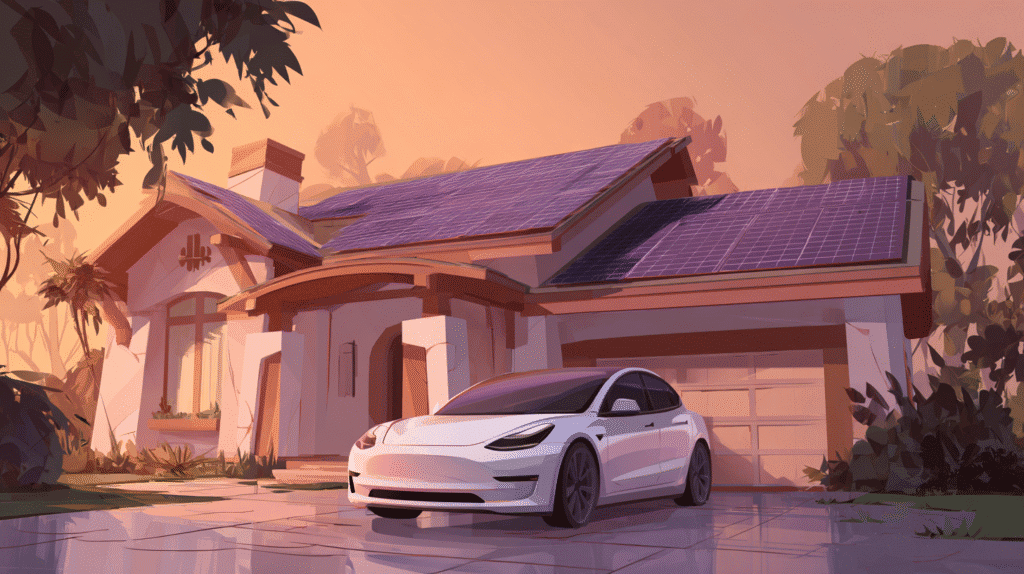
The electric vehicle parked in your driveway represents more than just transportation—it’s a massive battery on wheels capable of powering your home during outages, reducing your electricity bills, and creating a fully integrated energy ecosystem. As EVs become mainstream and smart home technology advances, the convergence of automotive and residential energy management is revolutionizing how we think about power consumption and sustainability.
Imagine your solar panels charging your car during the day, your EV powering your home during peak rate hours in the evening, and your smart energy management system automatically optimizing everything to minimize costs and maximize clean energy use. This isn’t science fiction—it’s available technology that thousands of homeowners are implementing today.
This comprehensive guide explores the practical reality of integrating electric vehicles into smart home energy systems. From understanding vehicle-to-home technology to selecting compatible equipment, from calculating realistic costs and savings to navigating utility programs and regulations, you’ll discover everything needed to create a truly integrated smart home and EV ecosystem that delivers tangible benefits while advancing toward energy independence.
Understanding the Smart Home Energy Ecosystem
Before integrating your EV, understanding how modern smart home energy systems work provides the foundation for successful implementation.
What Makes a Home Energy System “Smart”
Traditional homes consume electricity without awareness or optimization. Smart home energy systems actively monitor, analyze, and control energy flow throughout your home, making intelligent decisions to reduce costs and improve efficiency.
Key components of smart home energy systems include:
Smart electrical panels that monitor and control individual circuits, providing real-time visibility into which devices consume power and allowing remote control of specific circuits. Modern panels from Span, Leviton, and Schneider Electric replace traditional breaker panels with intelligent alternatives.
Energy monitoring systems that track consumption at the whole-home level or for individual circuits and appliances. Systems like Sense, Emporia Vue, and Neurio provide detailed insights into energy usage patterns, costs, and trends.
Smart thermostats from Nest, Ecobee, and others that learn your preferences, adjust automatically based on occupancy, and coordinate with other smart devices to optimize HVAC energy consumption—typically the largest residential energy user.
Connected appliances that communicate usage data and can be controlled remotely or scheduled to operate during off-peak energy periods.
Home automation systems like Apple HomeKit, Google Home, Amazon Alexa, or dedicated platforms like Home Assistant that coordinate all connected devices through unified control and automation rules.
The Role of EVs in the Energy Ecosystem
Electric vehicles introduce several unique characteristics to home energy systems:
Significant energy demand: A typical EV adds 3,000-10,000 kWh of annual electricity consumption—equivalent to adding another entire household to your electric service. This represents your largest controllable load and greatest opportunity for optimization.
Flexible charging schedule: Unlike most appliances that must operate when needed, EV charging typically happens overnight when the vehicle sits unused. This flexibility allows strategic timing to capture lowest electricity rates or maximum solar production.
Mobile energy storage: Modern EVs contain battery packs ranging from 40-100+ kWh—equivalent to several days of typical household consumption. With appropriate technology, this massive battery can serve as home backup power or grid support.
Predictable patterns: Most drivers follow consistent daily routines, making EV energy needs predictable and automatable. Your smart home system can learn these patterns and optimize accordingly.
Integration Benefits Beyond Cost Savings
While reducing electricity costs drives most integration efforts, additional benefits often prove equally valuable:
Energy independence from utility rate fluctuations and potential outages provides peace of mind and resilience. Your integrated system can operate autonomously, drawing from solar production and EV storage when grid power is unavailable or expensive.
Environmental benefits multiply when combining EVs with solar power. You eliminate not just tailpipe emissions but also indirect emissions from grid electricity generation, creating truly zero-emission transportation.
Demand response participation allows your system to support grid stability during peak demand events, often earning compensation from utilities while contributing to overall grid reliability.
Future-proofing your home for increasing electrification. As more appliances, tools, and vehicles electrify, having robust smart energy infrastructure positions you to accommodate these changes efficiently.
Vehicle-to-Home (V2H) and Vehicle-to-Grid (V2G): The Game-Changing Technologies
Bidirectional charging represents the most transformative aspect of EV-home integration, turning your vehicle from mere energy consumer into an active energy asset.
How Bidirectional Charging Works
Traditional EV charging flows electricity one direction: from your home to your vehicle. Bidirectional charging enables electricity to flow both ways, allowing your EV to supply power back to your home or the electrical grid.
This requires several technological components working together:
Bidirectional charger contains specialized electronics that can manage power flow in both directions while maintaining safety and battery health. These chargers cost more than standard units ($3,000-7,000 vs. $500-1,500) but enable V2H and V2G functionality.
Compatible vehicle with bidirectional charging capability. Not all EVs support this feature—it requires specific battery management systems and vehicle electronics designed to safely discharge as well as charge.
Integration hardware connects the bidirectional charger to your home electrical panel, allowing it to supply power to household circuits. This typically includes transfer switches, additional safety equipment, and specialized installation.
Control software coordinates when to charge the vehicle versus when to draw power from it, based on electricity rates, solar production, battery state of charge, predicted driving needs, and your preferences.
Vehicle-to-Home (V2H) Applications
V2H technology allows your EV to power your home during various scenarios:
Backup power during outages represents the most obvious application. When grid power fails, your EV automatically begins supplying electricity to essential (or all) home circuits. A typical EV with a 75 kWh battery can power an average home for 2-3 days, far exceeding traditional generator capabilities.
Peak shaving reduces demand charges and time-of-use costs by using vehicle battery power during expensive peak rate periods. Your EV charges overnight at low rates, then supplements home power during expensive afternoon hours, significantly reducing electricity costs.
Load shifting allows you to charge your EV during favorable conditions (low rates, high solar production) and use that stored energy whenever beneficial, effectively time-shifting your electricity consumption to optimize costs.
Grid event participation enables your V2H system to support your home during planned outages for maintenance or voluntary demand response events, earning incentives while maintaining home comfort.
Vehicle-to-Grid (V2G) Capabilities
V2G extends V2H by allowing your vehicle to interact directly with the electrical grid:
Grid stabilization services utilize aggregated EV batteries to provide frequency regulation, voltage support, and other grid services. Utilities need fast-responding resources to maintain grid stability, and coordinated EV fleets can provide these services while earning revenue for participants.
Renewable energy integration support uses EV batteries to store excess renewable generation when production exceeds demand, then discharge when renewable production drops. This helps maximize clean energy utilization.
Demand response programs pay participants to reduce grid demand during peak events. V2G systems can respond automatically, reducing home grid consumption and even supplying power back to the grid during high-value periods.
Energy arbitrage in markets with dynamic pricing allows your V2G system to buy low-cost electricity (even negative-priced electricity during excess renewable generation) and sell it back during high-price periods, creating profit opportunities.
Current V2H/V2G Vehicle Availability
As of 2024-2025, bidirectional charging capability remains relatively limited but is expanding:
Available now:
- Ford F-150 Lightning (with Ford Intelligent Backup Power)
- Ford Mustang Mach-E (select markets)
- Nissan Leaf (via CHAdeMO standard, older technology)
- Hyundai Ioniq 5 and Ioniq 6 (select markets)
- Kia EV6 (select markets)
- Volkswagen ID.4 (upcoming feature activation)
- Lucid Air (capability present, activation pending)
Announced for future models:
- General Motors (Ultium platform vehicles)
- Tesla (Cybertruck and potentially other models)
- Rivian (R1T and R1S)
- Most major manufacturers for future model years
Important note: Even vehicles with bidirectional charging hardware require compatible charging equipment and software integration to enable V2H/V2G functionality. Confirm compatibility before assuming your EV supports these features.
Integrating EVs with Solar Power Systems
Pairing solar panels with EV charging creates one of the most effective paths toward energy independence and cost savings.
Solar + EV Synergy
The combination of rooftop solar and electric vehicles offers compelling advantages:
Direct solar EV charging eliminates electricity costs for transportation entirely. When your vehicle charges from solar production, you drive on free, renewable energy generated on your own roof.
Increased solar ROI occurs when EVs provide additional load to absorb solar production. Many solar systems generate excess electricity during sunny midday hours when home consumption is low. EVs create useful load that captures this production rather than selling it back to utilities at unfavorable rates.
Grid independence increases substantially when solar production charges both your home and your vehicle. You reduce reliance on utility electricity for both stationary and mobile energy needs.
Time-shifting solar production through EV batteries allows you to capture midday solar energy and use it during evening peak demand hours, maximizing the value of your solar investment.
Solar Charging Strategies
Several approaches maximize solar EV charging effectiveness:
Manual solar-priority charging involves plugging in your EV during peak solar production hours (typically 10 AM – 3 PM) when panels generate maximum power. This simple approach requires no special equipment beyond standard Level 2 charging.
Automated solar tracking uses smart chargers that monitor solar production and adjust EV charging rates dynamically to match available solar power. When clouds reduce production, charging slows; when sun returns, charging increases. Systems like MyEnergi Zappi, Wallbox Pulsar Plus, and SolarEdge EV Charger provide this functionality.
Excess solar charging programs the charger to use only surplus solar production after satisfying home loads. The EV charges at whatever rate solar excess allows, from slow trickle charging to full power during optimal conditions.
Scheduled solar charging uses weather forecasts and historical production data to predict optimal charging windows, automatically charging during periods forecast for strong solar production.
Sizing Solar Systems for EV Charging
Adding an EV significantly increases electricity consumption, often requiring larger solar installations:
Typical EV consumption: 3,000-10,000 kWh annually depending on driving distance and vehicle efficiency. A driver covering 12,000 miles annually in an EV achieving 3 miles/kWh consumes approximately 4,000 kWh—roughly 30-40% of typical household consumption.
Solar sizing guidelines: Each kW of solar panel capacity generates approximately 1,200-1,800 kWh annually depending on location, tilt, shading, and system efficiency. To offset 4,000 kWh of EV consumption requires approximately 2.5-3.5 kW of additional solar capacity.
System costs: Solar installations cost approximately $2.50-3.50 per watt before incentives. Adding 3 kW for EV charging costs roughly $7,500-10,500 before the 30% federal tax credit, resulting in $5,250-7,350 net cost.
Payback calculations: If that 3 kW system generates 4,000 kWh annually worth $0.15/kWh, it saves $600 annually, providing payback in 9-12 years. Factor in gasoline savings versus EV charging costs, and total payback often occurs in 5-7 years.
Battery Storage Enhancement
Adding home battery storage to solar + EV integration creates ultimate flexibility:
Solar energy time-shifting stores excess midday production for evening EV charging or home use, maximizing solar utilization when direct consumption isn’t possible.
Backup power enhancement combines home battery and EV battery capacity, providing extended outage capability far exceeding either system alone.
Peak shaving draws from battery storage during expensive peak rate periods, using stored solar or off-peak electricity instead of expensive grid power.
Battery systems from Tesla (Powerwall), LG Chem (RESU), Enphase (IQ Battery), and others typically range from 10-20 kWh capacity per unit, with costs of $8,000-15,000 installed per unit before incentives.
Smart Charging Equipment and Technology
Selecting the right charging equipment and integrating it properly determines how effectively your EV participates in your smart home ecosystem.
Smart Charger Features and Capabilities
Modern smart EV chargers offer substantially more functionality than basic charging:
Wi-Fi/cellular connectivity allows remote monitoring and control through smartphone apps. You can start/stop charging, adjust charging rates, schedule sessions, and monitor energy consumption from anywhere.
Load balancing automatically adjusts charging power based on overall home electrical load, preventing circuit overloads and optimizing available capacity. This becomes crucial when running multiple high-power appliances simultaneously.
Scheduled charging programs charging to occur during specific time windows, typically overnight during off-peak rate periods. Advanced scheduling can account for variable rate structures and predicted departure times.
Solar tracking monitors solar production in real-time and adjusts EV charging rates to match available solar power, maximizing use of free renewable electricity.
Dynamic rate response interfaces with utility pricing signals, automatically adjusting charging to capture lowest rates and avoid highest rates. Some systems can automatically pause charging during critical peak events.
Energy monitoring tracks charging sessions with detailed data on energy delivered, costs, efficiency, and historical trends. This data integrates with whole-home energy monitoring for complete visibility.
OCPP compatibility (Open Charge Point Protocol) ensures interoperability with various energy management platforms and future-proofs your investment by avoiding proprietary systems.
Recommended Smart Chargers
Several manufacturers offer excellent smart charging solutions:
Tesla Wall Connector ($400-550)
- Seamless integration with Tesla vehicles
- Wi-Fi connectivity and app control
- Power sharing between multiple units
- 44-mile range per hour charging
- Limited third-party EV compatibility
ChargePoint Home Flex ($700-800)
- Universal J1772 compatibility
- Adjustable amperage (16-50A)
- Excellent app with detailed energy tracking
- Alexa integration
- Schedule and reminder features
JuiceBox 48 ($600-750)
- Strong app functionality
- Voice control (Alexa/Google)
- Energy monitoring
- Time-of-use pricing integration
- Smart Grid ready
Wallbox Pulsar Plus ($650-800)
- Solar tracking capability
- Power Boost load balancing
- Excellent app interface
- MyEnergi ecosystem integration
- Compact design
Emporia Smart EV Charger ($400-550)
- Integrated with Emporia energy monitoring system
- Excellent value
- Solar charging modes
- Strong app functionality
- Budget-friendly smart option
Autel MaxiCharger ($500-650)
- NACS/Tesla and J1772 compatibility
- Excellent build quality
- Smart scheduling
- Energy monitoring
- Good value proposition
Installation Considerations
Proper installation ensures safe, effective operation:
Electrical capacity assessment determines whether your panel can support EV charging. Most homes need 40-60 amp circuits for optimal Level 2 charging (30-50 miles range per hour).
Circuit breaker upgrades may be necessary if your panel lacks available capacity. Some homes require panel upgrades ($1,500-3,000) or load management systems ($500-1,500) to accommodate EV charging.
Charger placement affects convenience and cost. Locate chargers close to your panel to minimize wiring costs ($6-12 per foot of wire run) and near where you park for convenient plugging.
Hardwired vs. plug-in configurations affect flexibility. Hardwired installations are permanent and support higher power levels. NEMA 14-50 plug installations allow relocating chargers but typically limit power to 40 amps.
Permit requirements vary by jurisdiction. Most locations require electrical permits for charger installation ($50-200), and some offer expedited EV charger permit processing.
Professional installation is strongly recommended for safety and code compliance. Costs typically range from $500-1,500 depending on complexity, panel distance, and any necessary electrical upgrades.
Home Energy Management Systems
Coordinating all components of your smart home and EV ecosystem requires sophisticated energy management platforms.
Whole-Home Energy Monitoring
Several systems provide comprehensive energy visibility and control:
Sense Energy Monitor ($299-349)
- Installs in your electrical panel
- Uses machine learning to identify individual devices
- Real-time energy monitoring
- Solar production tracking
- Smart device integrations
- Detailed cost analysis
Emporia Vue ($150-200 for 8-circuit, $250-300 for 16-circuit)
- Excellent value for circuit-level monitoring
- Solar production monitoring
- Smart plug controls
- Carbon footprint tracking
- Rate tracking with utility integrations
- Works with Emporia EV charger
Span Smart Panel ($3,000-5,000 installed)
- Replaces entire electrical panel
- Circuit-level control and monitoring
- Backup power management
- Excellent app interface
- Smart home integration
- Future-proof platform
Schneider Electric Square D Energy Center ($2,500-4,000 installed)
- Smart panel replacement
- Circuit monitoring and control
- Surge protection integrated
- Backup power routing
- Professional-grade reliability
Energy Management Platforms
Software platforms coordinate your entire ecosystem:
Tesla app (for Tesla owners with Powerwall)
- Unified control of vehicle, charger, and home battery
- Storm Watch for automatic backup preparation
- Time-based control modes
- Energy flow visualization
- Self-powered mode optimization
Enphase Enlighten (for Enphase solar/battery systems)
- Solar production monitoring
- Battery status and control
- Energy independence tracking
- Utility rate integration
- Storm Guard for weather events
SolarEdge monitoring (for SolarEdge inverters)
- Production monitoring
- EV charging integration
- Energy independence metrics
- Smart device controls
- Battery management
Home Assistant (free, open-source)
- Ultimate flexibility and control
- Integrates virtually any smart device
- Complex automation capabilities
- Local control without cloud dependence
- Steep learning curve but powerful
Utility Integration and Programs
Many utilities offer programs supporting smart EV charging:
Time-of-use (TOU) rates provide lower electricity costs during off-peak hours (typically overnight and weekends). Moving EV charging to these periods can reduce costs 30-50% compared to flat rates.
EV-specific rate plans from many utilities offer even lower overnight rates specifically for EV charging. These plans typically require separate metering or smart charger data sharing but provide substantial savings.
Managed charging programs pay you to allow the utility some control over charging timing. You specify minimum requirements (vehicle charged by 7 AM, for example), and the utility optimizes within those constraints.
Demand response programs compensate participants for reducing consumption during peak events. Smart EV chargers can automatically respond, pausing charging during events and resuming afterward.
V2G pilot programs in select markets pay for bidirectional EV participation in grid services. Programs exist in California, Colorado, Maryland, and other states, with expansion expected.
Creating Automated Energy Optimization
The power of smart home and EV integration emerges through automation that optimizes energy use without requiring constant attention.
Automation Strategies
Dynamic charging schedules adjust based on multiple factors:
- Current electricity rates (lowest cost priority)
- Solar production forecasts (solar priority)
- Predicted departure time (ensure adequate charge)
- Battery state of charge (avoid excessive charging cycles)
- Grid conditions (respond to demand events)
Load coordination prevents overloading circuits:
- Reduce EV charging when dryer is running
- Pause charging during AC compressor operation
- Resume charging when major loads complete
- Balance total home consumption below limits
Solar maximization optimizes renewable energy use:
- Charge EV at maximum rate during peak solar production
- Reduce charging rate when clouds reduce production
- Store excess solar in home battery when EV is full
- Time heavy appliance use to coincide with solar production
Backup power management ensures readiness:
- Maintain minimum EV battery charge for driving needs
- Reserve additional capacity for potential outages
- Automatically prioritize critical home circuits during outages
- Coordinate home battery and EV battery for extended backup
Example Automation Scenarios
Scenario 1: Solar-Optimized Weekday Charging
Your automation system:
- Checks weather forecast each morning
- If sunny day predicted, enables solar tracking mode
- Begins EV charging when solar production exceeds home consumption
- Adjusts charging rate continuously to match solar availability
- Switches to grid charging at 3 PM if battery isn’t sufficiently charged
- Ensures vehicle is fully charged by 7 AM departure time
Scenario 2: Weekend Peak Shaving
Your system:
- Charges EV fully overnight Friday using low off-peak rates
- Maintains 80% charge through the weekend
- During Saturday afternoon peak rate period (2-8 PM), draws power from EV to supplement expensive grid electricity
- Powers home partially from EV, reducing grid consumption 40%
- Recharges EV overnight Saturday at low rates
- Ensures 100% charge by Monday morning commute
Scenario 3: Storm Preparation
Anticipating severe weather:
- Weather alert triggers Storm Mode
- System charges EV to 100% (vs. typical 80% daily charge limit)
- Home battery charges to 100%
- System notifications confirm backup power readiness
- If grid fails, automatic transfer to backup mode begins
- System prioritizes critical loads, rationing available battery capacity
- When grid restores, system returns to normal operation
Voice Control Integration
Smart assistants enhance usability:
Amazon Alexa commands:
- “Alexa, start charging my car”
- “Alexa, what’s my home energy consumption?”
- “Alexa, enable solar charging mode”
- “Alexa, is my car ready for my morning commute?”
Google Assistant integration:
- “Hey Google, pause EV charging”
- “Hey Google, how much solar power am I generating?”
- “Hey Google, set car to charge at midnight”
Apple HomeKit/Siri (supported devices):
- “Hey Siri, check my car’s charge level”
- “Hey Siri, turn on storm backup mode”
Cost Analysis: Investment and Returns
Understanding realistic costs and savings helps evaluate whether smart home and EV integration makes financial sense for your situation.
Initial Investment Costs
Basic smart charging setup ($1,000-2,500):
- Smart Level 2 charger: $400-800
- Professional installation: $500-1,500
- Electrical upgrades (if needed): $0-1,000
Enhanced monitoring integration ($1,500-3,500):
- Smart charger: $600-800
- Circuit-level energy monitor: $200-400
- Professional installation: $700-1,800
- Minor panel modifications: $0-500
Complete smart panel upgrade ($4,000-7,000):
- Smart electrical panel system: $3,000-4,500
- Professional installation: $1,000-2,000
- Smart charger: $600-800
- Integration and setup: $0-500
Solar + storage integration ($15,000-40,000):
- Solar panel system (5-10 kW): $12,000-28,000 after incentives
- Home battery storage: $8,000-15,000 after incentives
- Smart charger with solar tracking: $600-800
- Integration costs: $500-1,500
Bidirectional V2H system ($8,000-15,000):
- Bidirectional charger: $3,000-7,000
- Transfer switch and integration hardware: $2,000-4,000
- Professional installation: $2,000-4,000
- Permits and inspections: $500-1,000
Ongoing Savings
Electricity cost reduction from optimized charging:
- Average driver (12,000 miles): $600-800 annually vs. unmanaged charging
- Time-of-use optimization: 30-50% reduction in EV charging costs
- Example: $1,200 annual charging costs reduced to $600-840
Solar EV charging value:
- Free fuel: $1,200-1,800 annually vs. grid charging
- Increased solar ROI from utilizing excess production
- Energy independence benefits (hard to quantify)
Peak shaving savings (TOU rate plans):
- Typical household: $200-500 annually
- Larger homes or hot climates: $500-1,200 annually
- Requires home battery or V2H capability
Demand response incentives:
- Managed charging programs: $50-200 annually
- V2G pilot programs: $500-2,000 annually (where available)
- Variable based on participation level
Payback Analysis Examples
Example 1: Basic Smart Charging
Investment: $1,500 (charger + installation) Annual savings: $400 (time-of-use optimization) Payback period: 3.75 years Lifetime value (10 years): $2,500 net benefit
Example 2: Solar Integration
Additional investment: $7,000 (solar expansion for EV) Annual savings: $1,200 (free EV fuel) Additional value: $600 (increased solar ROI) Payback period: 3.9 years Lifetime value (25 years): $38,000 net benefit
Example 3: Complete V2H System
Investment: $12,000 (bidirectional charger and integration) Annual savings: $800 (optimized charging + peak shaving) Backup power value: $200/year (generator replacement) Payback period: 12 years Intangible benefits: Outage resilience, energy independence
Practical Implementation: Step-by-Step Guide
Successfully integrating your EV with your smart home requires systematic planning and execution.
Phase 1: Assessment and Planning (Week 1-2)
Evaluate your current setup:
- What’s your existing electrical panel capacity?
- Do you have solar panels or plan to install them?
- What’s your current energy monitoring capability?
- What smart home devices already exist?
Define your goals:
- Primary objective: Cost savings? Backup power? Environmental impact?
- Budget constraints and timeline
- Level of technical involvement desired (DIY vs. professional)
- Future expansion plans
Research your utility programs:
- Available rate plans (TOU, EV-specific rates)
- Managed charging programs
- Demand response opportunities
- V2G pilot programs
- Interconnection requirements for bidirectional systems
Assess your EV compatibility:
- Smart charging capabilities
- Bidirectional charging support (current or future)
- Integration with specific platforms
- Required adapters or equipment
Phase 2: Core Installation (Week 3-6)
Install smart charger:
- Hire licensed electrician for assessment
- Obtain necessary permits
- Schedule installation (typically 4-8 hours)
- Test and verify operation
- Set up mobile app and connectivity
Implement energy monitoring (if not already present):
- Select appropriate monitoring system
- Professional installation in electrical panel
- Configure mobile app and calibrate
- Verify accurate monitoring of all circuits
- Establish baseline energy consumption data
Set up basic automations:
- Configure charging schedules for off-peak rates
- Enable mobile notifications
- Create backup charging scenarios
- Test all functionality
Phase 3: Optimization and Integration (Week 7-12)
Integrate with smart home platform:
- Connect charger to home automation system
- Link energy monitor to smart home hub
- Create advanced automation rules
- Configure voice control
- Test integrated scenarios
Implement solar tracking (if applicable):
- Connect solar monitoring to charger
- Configure solar-priority charging modes
- Optimize charge rate algorithms
- Monitor and refine over several weeks
Enroll in utility programs:
- Apply for appropriate rate plans
- Register for managed charging programs
- Submit required documentation
- Configure charger for program participation
Phase 4: Advanced Features (Ongoing)
Refine automations based on actual usage patterns:
- Adjust charging schedules seasonally
- Optimize solar tracking algorithms
- Fine-tune load balancing thresholds
- Incorporate weather forecasts
Expand system capabilities:
- Add home battery storage
- Upgrade to bidirectional charging
- Install additional monitoring
- Integrate new smart devices
Monitor and maintain:
- Review energy reports monthly
- Track savings and adjust strategies
- Perform software updates
- Schedule annual electrical inspections
Overcoming Common Challenges
Even well-planned integrations encounter obstacles. Understanding common issues helps prevent or quickly resolve them.
Electrical Capacity Limitations
Problem: Your electrical panel lacks capacity for EV charging while operating other major appliances.
Solutions:
- Install load management system (Span, Neurio, or similar)
- Use smart charger with load balancing features
- Upgrade electrical panel (expensive but comprehensive)
- Implement automated load coordination
- Consider lower-power Level 2 charging (24-32A vs. 48A)
Incompatible Equipment
Problem: Your EV, charger, solar system, and smart home platform don’t communicate effectively.
Solutions:
- Research compatibility before purchasing equipment
- Use middleware platforms (Home Assistant, IFTTT) to bridge systems
- Select equipment supporting open standards (OCPP, OpenADR, Matter)
- Consider replacing incompatible components if benefits justify costs
- Accept manual management of non-integrated components
Utility Program Complexity
Problem: Understanding and enrolling in utility programs proves confusing and time-consuming.
Solutions:
- Contact utility customer service for guidance
- Request cost analysis comparing rate plans
- Join online communities for experiences and advice
- Start with simple TOU rates before complex programs
- Use third-party services that simplify enrollment
Software and Connectivity Issues
Problem: Smart chargers lose Wi-Fi connection, apps crash, or automations fail.
Solutions:
- Use strong, dedicated Wi-Fi access points near charger
- Keep all firmware and apps updated
- Create backup manual charging schedules
- Document automation logic for troubleshooting
- Consider local control options (Home Assistant) reducing cloud dependence
Bidirectional Charging Permitting
Problem: Local utility or code enforcement blocks V2H/V2G installation due to interconnection requirements or lack of familiarity.
Solutions:
- Work with experienced solar/storage installers familiar with processes
- Provide educational materials to permitting authorities
- Request utility interconnection requirements in writing
- Consider starting with basic systems, adding bidirectional later
- Join advocacy groups working to streamline approval processes
Future Developments and Emerging Technologies
The smart home and EV integration landscape continues evolving rapidly.
Vehicle-to-Everything (V2X) Expansion
Broader adoption of bidirectional charging across more vehicle models will occur as:
- Battery costs decline, making V2X economically viable
- Standards mature (CCS bidirectional, SAE J2847)
- Utilities develop programs supporting V2G
- Homeowners recognize value proposition
Expected timeline: Mainstream adoption in 3-5 years as next-generation EVs launch with standard bidirectional capability.
Wireless Charging Integration
Inductive charging eliminates cables entirely:
- Drive over charging pad, automatic charging begins
- Seamless integration with automated parking
- Reduced wear on connectors and cables
- Higher costs but improving convenience
Current status: Available on some luxury EVs, expanding to mainstream vehicles over 5-10 years.
AI-Powered Optimization
Machine learning will enable increasingly sophisticated optimization:
- Predictive charging based on learned driving patterns
- Weather-aware solar forecasting and charging adjustment
- Automated participation in energy markets
- Anomaly detection identifying system problems
Implementation: Already beginning in premium systems, expanding to mainstream platforms over 2-5 years.
Grid Integration Maturity
Virtual power plant aggregation will coordinate thousands of EVs:
- Distributed EV batteries providing grid services at utility scale
- Automated participation in energy markets
- Enhanced compensation for participation
- Simplified onboarding and management
Regulatory progress: Pilot programs operating today, broader rollout expected over 5-10 years as regulations evolve.
Solid-State Battery Impact
Next-generation batteries will enhance integration capabilities:
- Higher energy density (longer range, more backup capacity)
- Faster charging (reduced optimization requirements)
- Longer cycle life (more cycles available for V2G)
- Improved safety (enabling more aggressive utilization)
Timeline: Limited availability 2025-2027, mainstream adoption 2030+.
Conclusion: Building Your Integrated Energy Future
Integrating your electric vehicle with your smart home energy system represents more than a technical upgrade—it’s a fundamental shift in how you relate to energy consumption, sustainability, and resilience. By treating your EV as an active participant in your home’s energy ecosystem rather than just another appliance, you unlock substantial benefits while positioning yourself for the energy future taking shape around us.
The path to successful integration doesn’t require starting with the most advanced, expensive system. Begin with smart charging to capture immediate savings through optimized timing. Add solar panels when roof replacement or energy costs justify investment. Incorporate home batteries as technology matures and costs decline. Upgrade to bidirectional charging when your next vehicle supports it and local programs provide value.
Each step delivers incremental benefits while building infrastructure supporting future capabilities. The smart home and EV integration journey is exactly that—a journey of continuous improvement rather than a destination requiring immediate perfection.
Key insights for successful integration:
Start with clear goals aligned with your situation. Cost savings, backup power, environmental impact, and energy independence all represent valid objectives requiring different approaches. Define priorities to guide equipment selection and system design.
Invest in quality foundational infrastructure. Smart electrical panels, circuit-level monitoring, and capable chargers support future expansion without requiring replacement. Cutting corners on foundation components often proves more expensive long-term.
Leverage professional expertise for electrical work and complex integrations. DIY efforts work well for software configuration and automation, but electrical installation requires proper expertise for safety and code compliance.
Participate in utility programs to maximize returns. Time-of-use rates, managed charging programs, and demand response incentives significantly enhance financial benefits. These programs often provide larger returns than equipment upgrades.
Plan for the future even if not implementing immediately. Wiring for bidirectional chargers, installing smart panels supporting V2H, and selecting expandable monitoring systems costs little more today while providing flexibility for future capabilities.
Monitor, measure, and optimize continuously. Smart systems generate tremendous data—use it to understand patterns, identify opportunities, and refine automation. The most sophisticated equipment delivers minimal value without thoughtful optimization.
The convergence of smart homes and electric vehicles isn’t distant future speculation—it’s practical reality delivering measurable benefits today. From reducing electricity costs 30-50% through intelligent timing to powering your home for days during outages, from achieving truly zero-emission transportation through solar charging to generating income through grid services participation, the benefits span financial, practical, and environmental dimensions.
As you consider integrating your EV with your smart home, remember that perfection isn’t required for success. Start where you are, implement what makes sense for your situation, and expand capabilities as opportunities and technologies evolve. The future of home energy is already here—and it’s parked in your driveway.
For additional resources about smart home and EV integration, the Department of Energy’s Office of Energy Efficiency and Renewable Energy provides research and guidance on residential energy systems. EnergySage offers tools for comparing solar and battery storage options, while EV-focused communities provide practical advice from homeowners who’ve completed similar integrations.
Your journey toward integrated smart home and EV energy management begins with a single step. Take it today, and discover how intelligently managing energy transforms not just your utility bills, but your entire relationship with how you power your life.